
Maddie Appelt started using Kalshi on Sept. 19, within two days she was in $20,000 of debt.
“I thought it was like a stock market,” she said. Appelt, a 25-year-old from Ohio had never gambled before, and had always stayed away from the activity for her mental health. The platform appealed to her as a financial tool through promotions at Ohio State football games, Tiktok, and Reddit, she said. She called it “very predatory” advertising.
“It destroys you and can bring you to your knees.”
— Maddie Appelt
Appelt put in $500 on the odds of the price of Bitcoin, in the span of 20 minutes she made $10,000.
Following her success, she returned to trade half her earnings the next day. “I ended up losing the $5,000, and then I went and tried to get it back by betting more and more till I got to the point where I'm now $20,000 in debt with three maxed out credit cards,” she said.
Appelt took out a loan against one of her bank accounts and is now looking for work. In another attempt to recoup her losses, she redownloaded Kalshi the day before the interview. “I'm stressed, very stressed, and it's hard to sleep at night,” she said. “It destroys you and can bring you to your knees.”
Appelt is not alone. Gen Z is looking for a new way to make money, and prediction market companies are positioning themselves to capitalize on this demand.
The Prime Environment
As more than half of young Americans have reported delaying major financial milestones amid economic uncertainty, platforms such as Kalshi and Polymarket are offering a new entertaining and accessible way to make quick earnings: put your knowledge to work by trading peer-to-peer on the outcome of future events, from elections and sports games to pop-culture moments.
The concept caught the attention of women across the nation this year. A national survey released in April found that 23% of women ages 18 to 34 reported using prediction markets. Kalshi says the share of its female account holders doubled from 13% to 26% in 10 months. Elisabeth Diana, Kalshi’s head of communications shared the statistics with The Atlantic in April, saying that if women start “using them en masse,” prediction markets will “burrow into American life even more deeply.”
For some young women, prediction markets are a casual way to make reality TV or sports more interesting. For others, they represent a potential source of income, and a way to enter a financial market dominated by men.
But as prediction market companies court this demographic through female influencers and online communities, questions remain about what they are actually selling: a financial tool, a side hustle, or gambling by another name?
Bank Of America reported that Gen Z is a strong participant in the “little treat economy,” defined as spending money on beauty, jewelry, coffee and travel. “This suggests younger consumers are prioritizing purchases and experiences that deliver immediate gratification,” says the report, “To maintain these spending priorities and pursue longer-term goals, Gen Z may be seeking additional income sources.”
One additional income source promoting immediate gratification is prediction markets. A January report report from Northwestern Mutual found that among those interested in prediction markets, sports betting, crypto, options or meme stocks, 80% of Gen Zers say it’s because they feel financially behind and think these platforms can help them reach their financial goals more than traditional methods.
The Appeal of a Quick Win
Alaina Sanbrano, a 22-year-old veterinary assistant from Huntington Beach, started using Kalshi over this past summer. Her curiosity was sparked by the idea of making the World Cup games more interesting.
“Kind of like gambling, it’s high intensity and you are more invested because you have money on the line,” said Sanbrano. “It’s similar to being at the casino, seeing all the lights, the fast moving wheels, it’s all very engaging and winning a bet is great.”
Her most recent trade was made on the Oct. 1 Steelers vs. Brown's game, where she lost 20 dollars. “I’m never putting my life savings, but it’s still a bummer,” she explained. “At the end of the day it’s money that could go somewhere else.”
While she mostly places trades on sports, Sanbrano also occasionally uses Kalshi to predict other forms of entertainment. Over the summer, she and her boyfriend raised the stakes of their nightly viewing of the famous reality dating show “Love Island USA," through placing trades on various aspects of the show. During the airing of the show in June, Kalshi's active female mobile users rose 106%.
Sanbrano recalled putting money towards how many times the contestants would say the words “Casa Amor” in an episode.
“It’s not an addiction,” she said. “I mostly do it when I’m sitting at a bar or restaurant and watching an event when I’ll think ‘should I put some money on this?’ because it’ll make it more fun.”
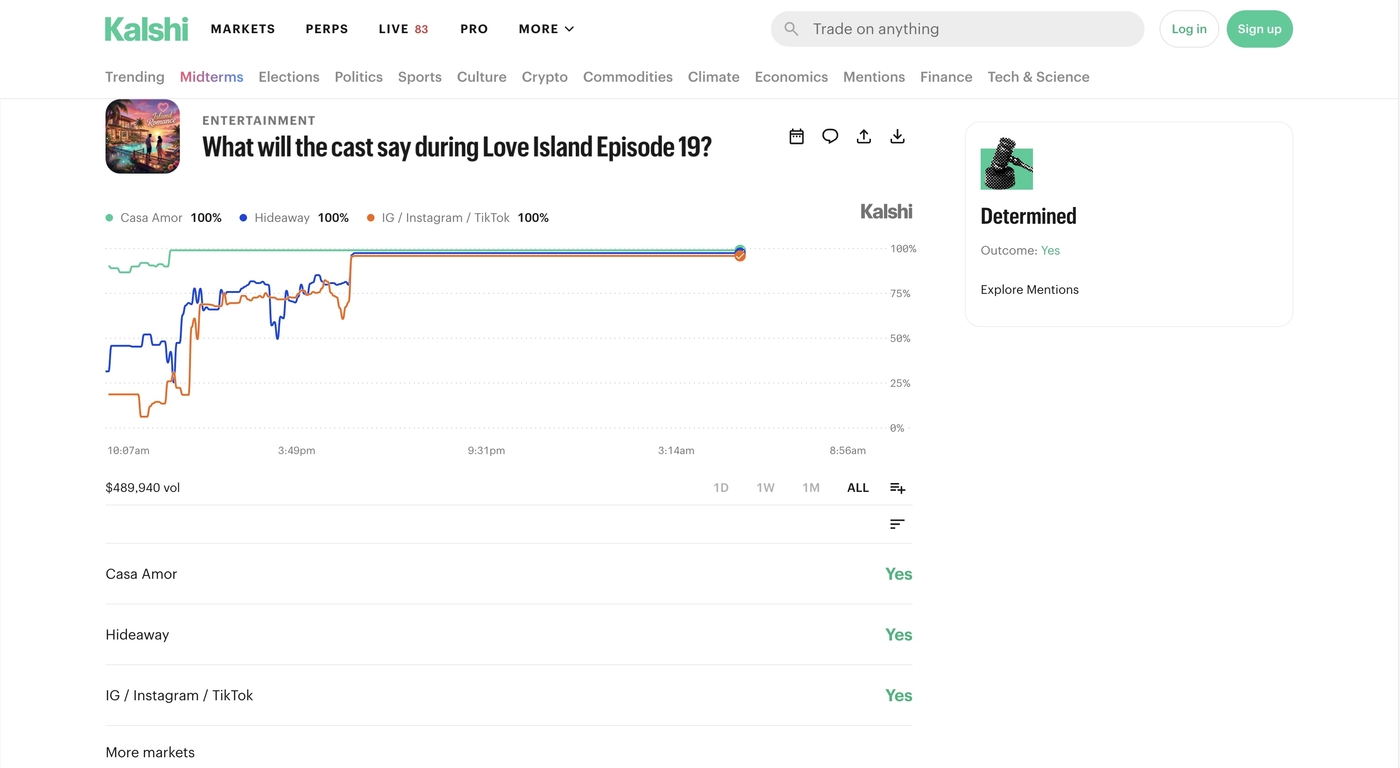
Kalshi trading volume of over $400,000 on if the cast of Love Island USA will say "Casa Amor", "Hideaway", "IG/Instagram/TikTok", in Season 8 episode 19 (Love Island USA/Kalshi.com).
The New Face of Prediction Markets
Prediction-market companies aren't waiting for young women to find them, they're actively recruiting them through social media influencers across platforms. Lillie Rohan, also known as @newswithlils on TikTok, was contacted by Kalshi for a partnership a few months ago. The partnership goes as such: she posts about pop culture events and simultaneously promotes the prediction market app. Rohan’s recent video on predicting who may go home on Dancing with the Stars (a market that crossed $1 million in trading volume by the end of last year on Kalshi), has 13,000 views.
“The reason why I got involved in the first place is because I think trading and prediction markets are predominantly a male space,” said Rohan. “I think it can feel very intimidating as a woman to try and get into that space.”
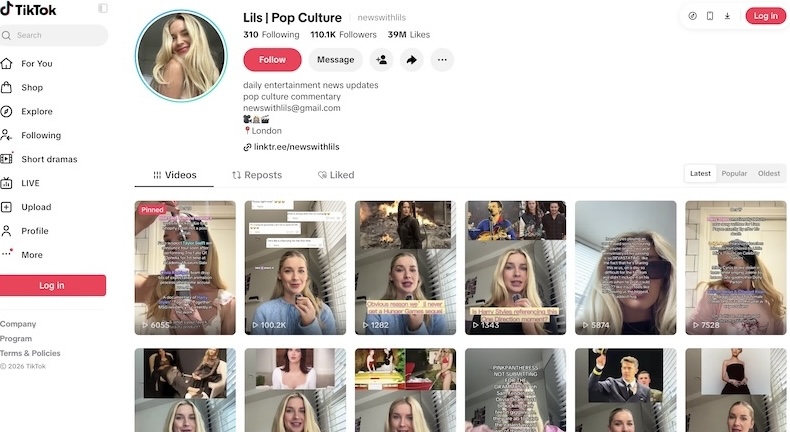
Rohan's TikTok account has more than 100,000 followers and over 39 million likes (Newswithlils/TikTok).
Rohan explained that within her partnership, there are certain guardrails to her content. She can’t use the words “gambling” or “betting.”
“They don’t want to be misrepresented,” she said.
Rohan lives in the United Kingdom, where prediction markets have been banned since 2019 due to the risk of consumer harm. While she isn’t geographically eligible, her reach is still essential to Kalshi. Rohan explained she has a predominantly American audience, with three-quarters of her viewership located in the states, and about 98% of this audience being women ranging from 18 to 25.
“Having [prediction markets] on social media is just a way to normalize them, and whether that's a good or a bad thing is probably down to personal opinion.” said Rohan. “You could probably ask the same thing about something like OnlyFans or TikTok, if you're giving people the ability to make money, then that can be empowering.”
What Is The Biggest Misconception People Have of Prediction Markets?
Women with varying viewpoints provide their input on the reality of this divisive new market
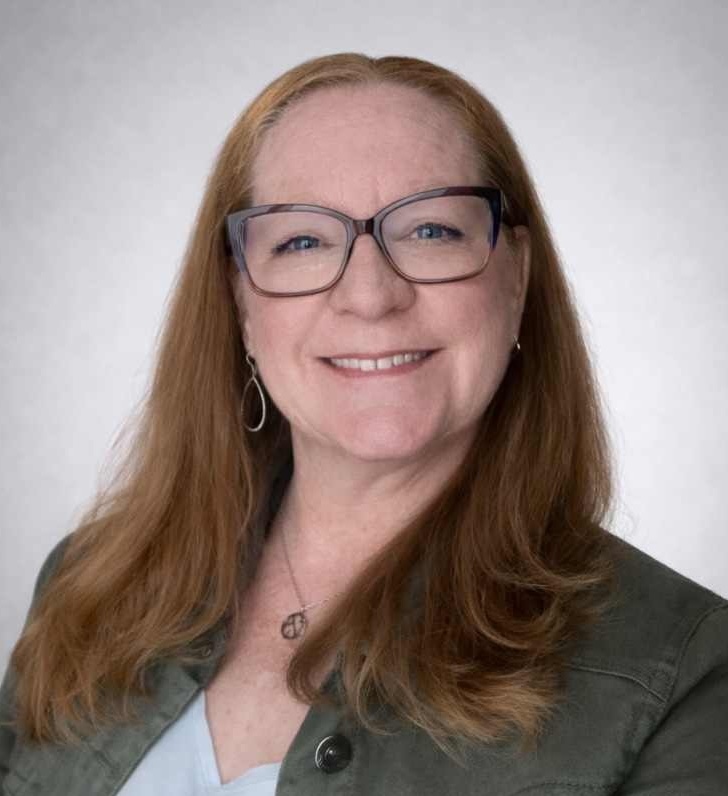
Kim Freudenberg

Lillie Rohan
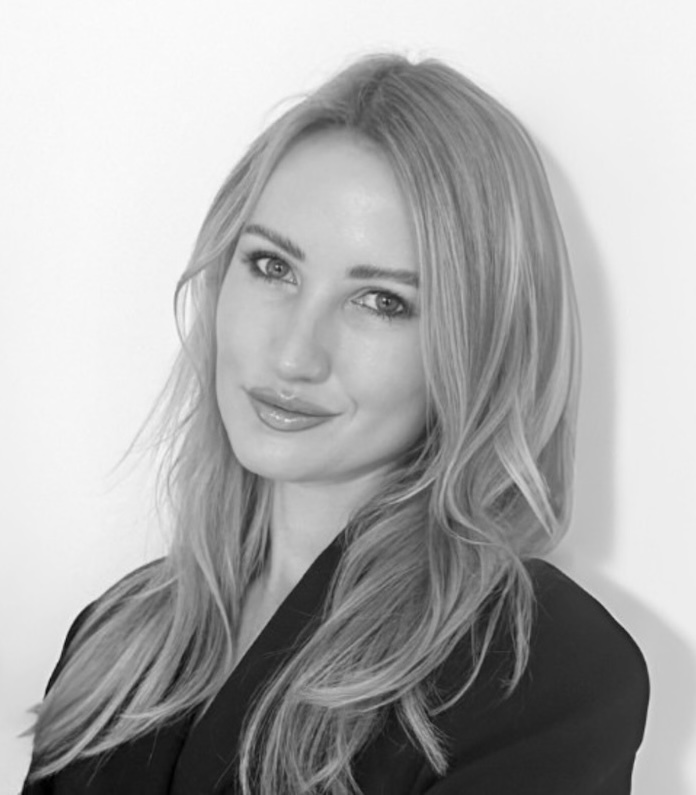
Agnese Rozite
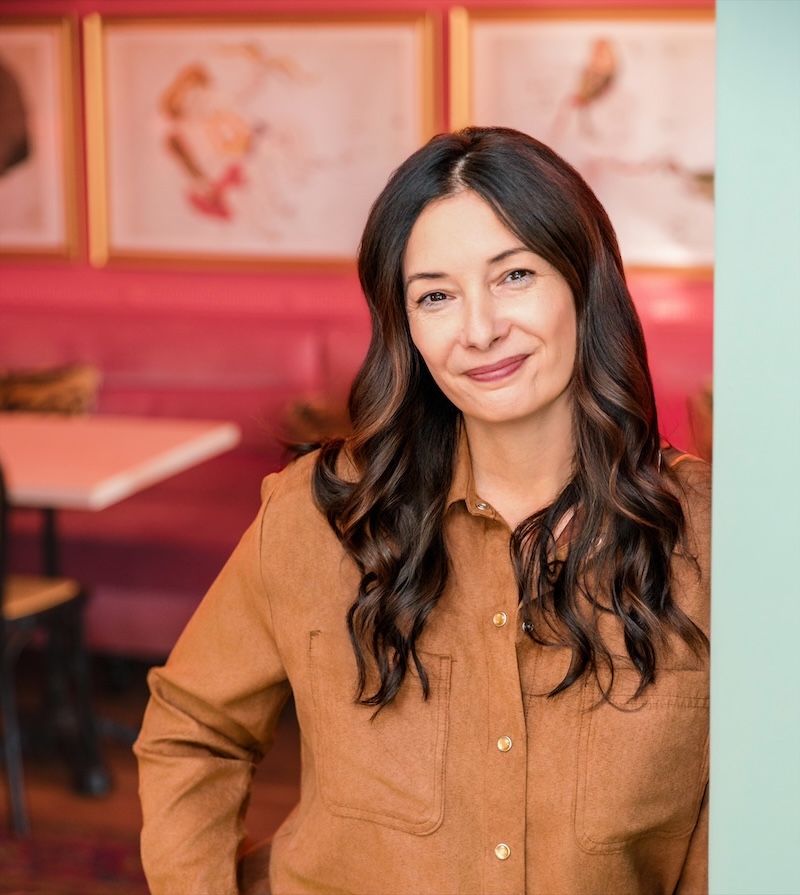
Christina Cook
The Unstoppable Trend
For women who want to take prediction markets beyond casual trades, a growing community has emerged on X. One page that amassed a large following was @Kalshigirls, started by Agnese "Aggie" Rozite, a Latvian-American entrepreneur, also known as @BlondiePredicts on X. Rozite started trading on prediction markets last July, and posted about her trades on social media early on. She was swiftly approached by the prediction market platform to form a partnership.
As a prediction markets affiliate for Kalshi, it was her job to use her platform to make prediction markets culture more accessible for women. “I realized the opportunity and didn't want to be left behind in a way, and also was kind of just tweeting ‘Hey, let's not make the same mistakes as traditional finance and crypto’ and try to get women in early,” said Rozite.
Rozite wasn’t the only woman on X interested in making the space more accessible. Similar communities have emerged around Polymarket. @Polybaddies, which has amassed more than 4,000 followers on X since it joined the platform a year ago, describes itself as a space for women in prediction markets. Its “Unofficial Polybaddie Oath,” pinned as the first post a viewer sees when entering the page, encourages members to view bringing new users into the market as being equally as valuable as winning a trade.
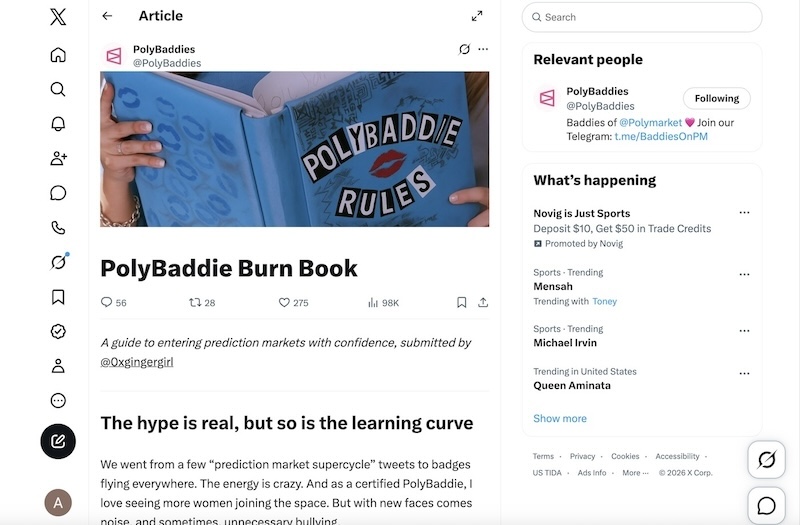
The Polybaddie Burn Book (Polybaddies/X).
Rozite explained that platforms like Kalshi and Polymarket are in their “celebrity era” currently, and attributes the growth of female users to this shift in marketing strategy. In June, renowned actor and global heartthrob Timothee Chalamet starred in an ad campaign for Kalshi. Polymarket launched a new social trading feature with a star-studded ad “Polymarket HQ,” in which Lebron James parades around a chaotic office space filled with the biggest names in entertainment and sports, including Eli Manning, Alexandra Daddario and Spike Lee.
“All the platforms are trying to put their name out there by advertising heavily and making partnerships with celebrities and things like that,” said Rozite. “I think that obviously helps to get new users, including women. Maybe somebody has a good experience, and they tell their girlfriends, and then they do it, it's more social.”
Rozite’s partnership with Kalshi is now terminated, and @Kalshigirls is no longer active, but Rozite is still an avid supporter of the prediction market space. She recently held her first event for “Prediction Market Day,” a holiday coined by her to celebrate the different figures within the industry and the history of prediction markets.
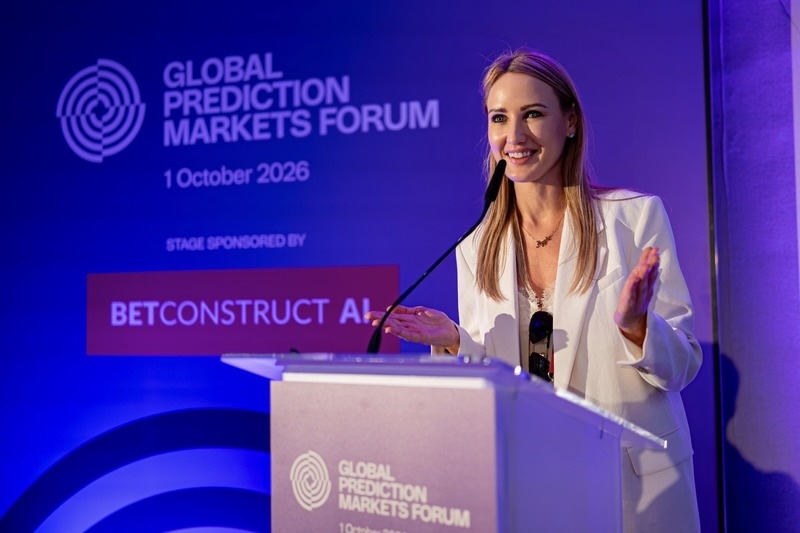
Agnese Rozite at the Global Prediction Markets SBC Summit in Lisbon (Courtesy of Agnese Rozite).
She explained that the space was exciting when she initially joined, and the recent growth only adds opportunity. “Everybody's super bullish,” said Rozite.
While users may be excited about this emerging marketplace, the growing popularity of prediction markets has caused Congress to debate exactly what these platforms are.
44 states jointly sent a letter in July addressed to the Commodity Futures Trading Commission (CFTC) demanding state authority to regulate, claiming prediction markets are “a new form of casino.” 19 states are in active litigation concerning regulation.
Rozite isn’t worried. “I think the space is here to stay, no matter what happens with the Supreme Court,” she said. “It's just growing faster than human experts are predicting, so I think that will also bring more women into the space as well. It's a trend that's unstoppable.”
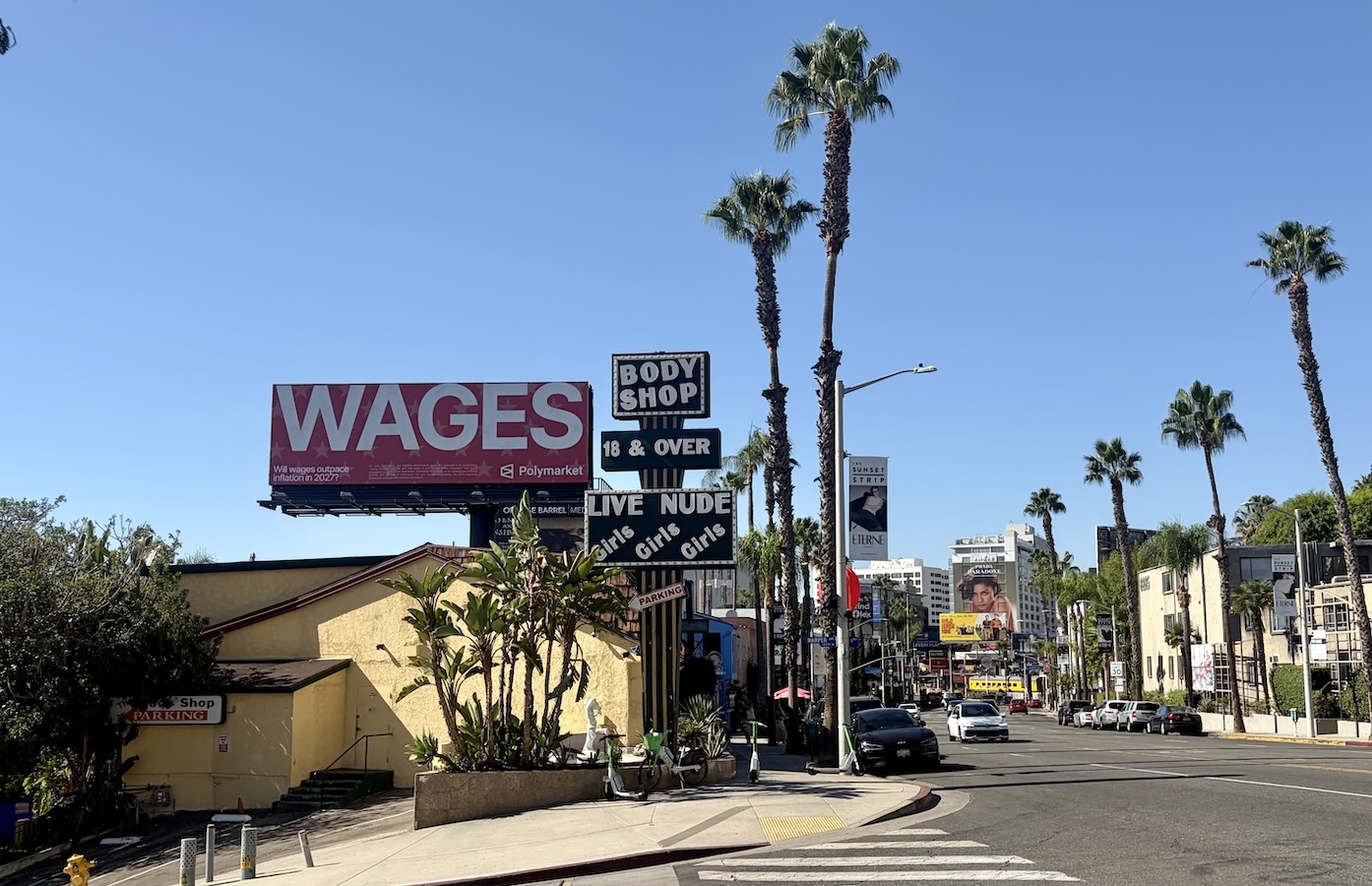
Polymarket ad on the Sunset Strip in West Hollywood promoting trading on whether wages will outpace inflation in 2027.
Gambling by Another Name
Those who have been impacted by gambling addictions are skeptical of the growing presence of prediction markets.
Christina Cook, founder of The Broke Girls Society, was addicted to gambling for 15 years. She has now built a community for women to speak about their own struggles with disordered gambling. Cook said prediction markets are a new form of gambling, and has found that the majority of women turn to the activity as a form of escapism.
“It's just about a little bit of me time, a little bit of time away from everything else, that's where that's where the relationship starts,” she explained. “It depends on what's going on in somebody's life, on how that relationship continues to build and become dangerous.”
Kim Freudenberg, a certified International Gambling Recovery Specialist and President of Parents Standing Together, a nonprofit organization dedicated to supporting families dealing with youth gambling addiction, fears that prediction markets are a new way young people are being exposed to gambling addictions.
"It doesn't matter what you call it or who regulates it, the harm that people experience is the same."
— Kim Freudenberg
She said the concept of prediction markets not having a house edge is a strategy utilized to differentiate themselves from traditional gambling. “Legally it might make it different, but to somebody who especially has a young brain that isn't processing risk that well yet, the dopamine cycles in it are exactly the same,” she said. “It doesn't matter what you call it or who regulates it, the harm that people experience is the same.”
Appelt was someone who experienced that harm firsthand, and is still struggling,“It changes me into a different person whenever I get into it, it's meant to be addictive,” she said. “It's meant to hook you in. It's designed in a way that is not hard on the eyes, and I can stare at it for hours.”