By Michelle Cisneros
On any given day, the hallways of Kheir Clinic are teeming with patients. Elderly patients stretch to maintain mobility, moms-to-be attend check-ups and children await their teeth cleaning. Staff manage all of it, day in and day out.
“We have a room full of toys, formula, diapers… we have canned food in there,” said James An, the director of patient resources and outreach during a visit to the clinic. “We try to do what we can.”
For decades, community clinics like Kheir have been tasked with filling gaps left by America’s complex health insurance system. And the clinics could soon become even busier.
A May 2026 Berkeley report predicts that the rate of uninsured Californians may double by 2030 due to several federal and state policy decisions. Southern California, especially L.A., may see some of the largest increases because of its large immigrant population and number of unemployed people who don’t meet the work exclusion requirements.
At the same time, Proposition 44 could transform the way community clinics are run by shifting many budget decisions to the state.
These clinics receive their funding from the federal government and donors. As nonprofits, they tend to operate on razor-thin margins. Louise McCarthy, president and CEO of the Community Clinic Association of Los Angeles County, said clinics are focused on helping people retain their insurance amid the new requirements. Although community clinics serve patients regardless of insurance, coverage helps offset the cost of care.
“If we go back to the old days before the Affordable Care Act, where clinics start seeing the majority of their patients being uninsured, they're going to be hard-pressed to be able to maintain those types of services,” McCarthy said.
A Berkeley report from earlier this year predicts the number of uninsured Californians may double by 2030. The ripple effect across the state’s entire healthcare system could impact community clinics. Click below to learn more about the issues these vital sources of healthcare could face.
Challenges of today & tomorrow
For community clinics, adapting to ever-changing federal actions is nothing new. Last November, when a government shutdown delayed food benefits, Kheir organized a food distribution. To accommodate Koreatown’s diverse population, staff ordered cultural staples such as rice, beans and halal meat.
Community clinics care for underserved populations regardless of health insurance at little to no cost. They see more than two million patients a year in L.A., with the majority being low-income.
For these clinics, adapting to ever-changing federal actions is nothing new. Last November, when a government shutdown delayed food benefits, Kheir organized a food distribution. To accommodate Koreatown’s diverse population, staff ordered cultural staples such as rice, beans and halal meat.
“It's kind of up to people that are boots on the ground in the community to have those relationships and a really good understanding of what the community currently needs,” An, one of Kheir’s directors, said. “That's what keeps us kind of going here.”
These changes will affect the almost 14 million people on Medi-Cal like Filiberto, identified by first name only for privacy reasons, who visited Kheir because his children’s Medi-Cal was recently deactivated.
His two youngest children had small bumps on their bodies that needed to be checked. The clinic enrolled his children into Medi-Cal under presumptive eligibility, which allowed them to reserve an appointment for the next day.
“The whole family is enrolled here at the clinic,” Filiberto said in Spanish. “We get all types of services here, thank god.”
Before he left, Filiberto went over the appointment details with a Kheir employee and picked up a bag of free baby supplies.
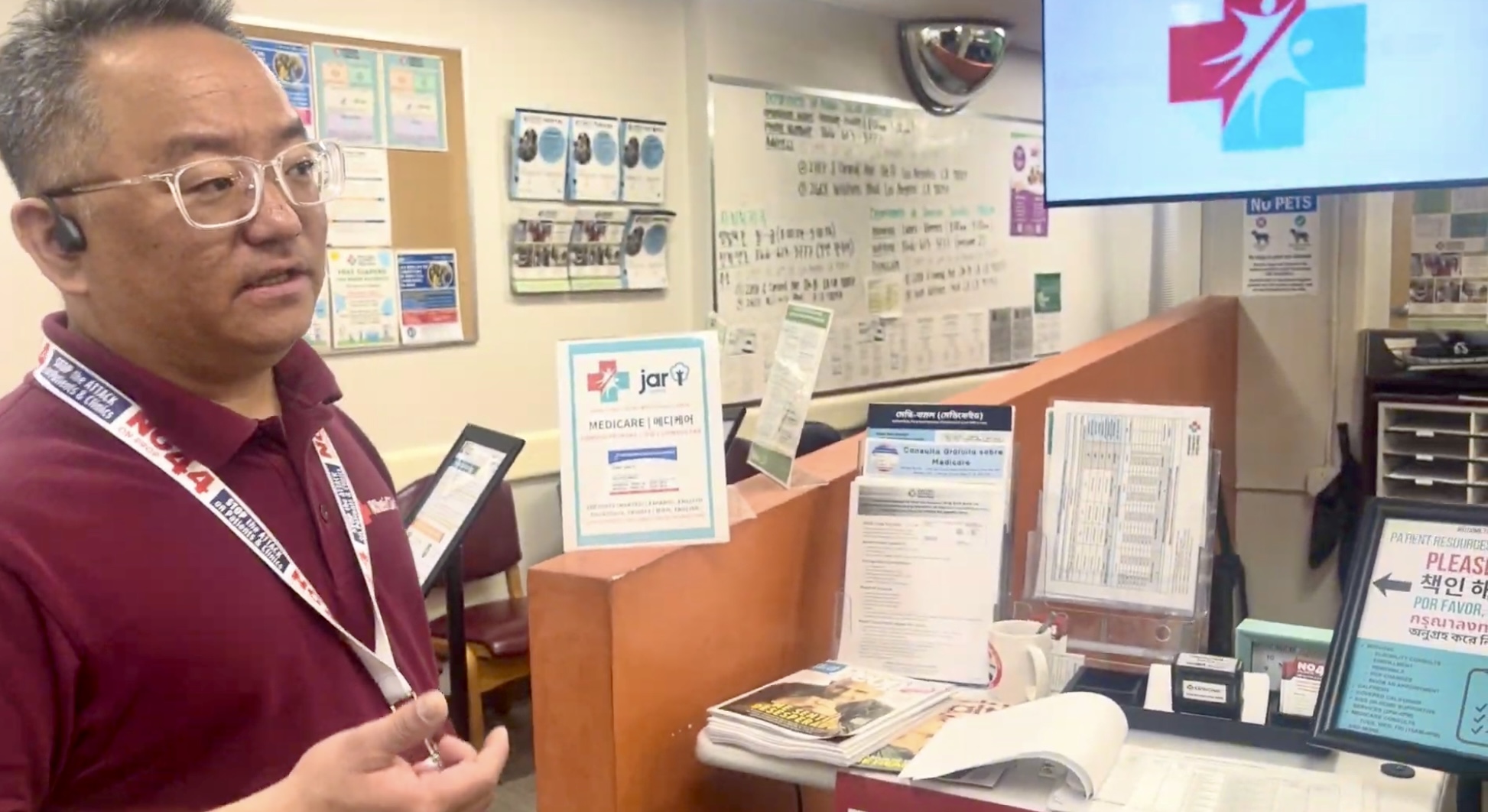
James An, the director of patient resources and outreach at Kheir Clinic, explains how patients receive help with insurance enrollment. (Photo by Michelle Cisneros)
One state policy change contributing to less coverage is the Medi-Cal enrollment freeze for undocumented immigrants, which took effect at the start of 2026. Next year, work requirements will increase for certain working-age adults.
“So much of our work is politics. It relies on all of these politicians changing their mind every two to four years,” said Leigh Stenberg, UMMA Clinic’s chief strategy officer.
The Berkeley report identified other key policies that will lead to fewer uninsured Californians. Several target migrant populations, such as undocumented immigrants, asylum seekers, refugees and other people with “unsatisfactory immigration status” under state definition.
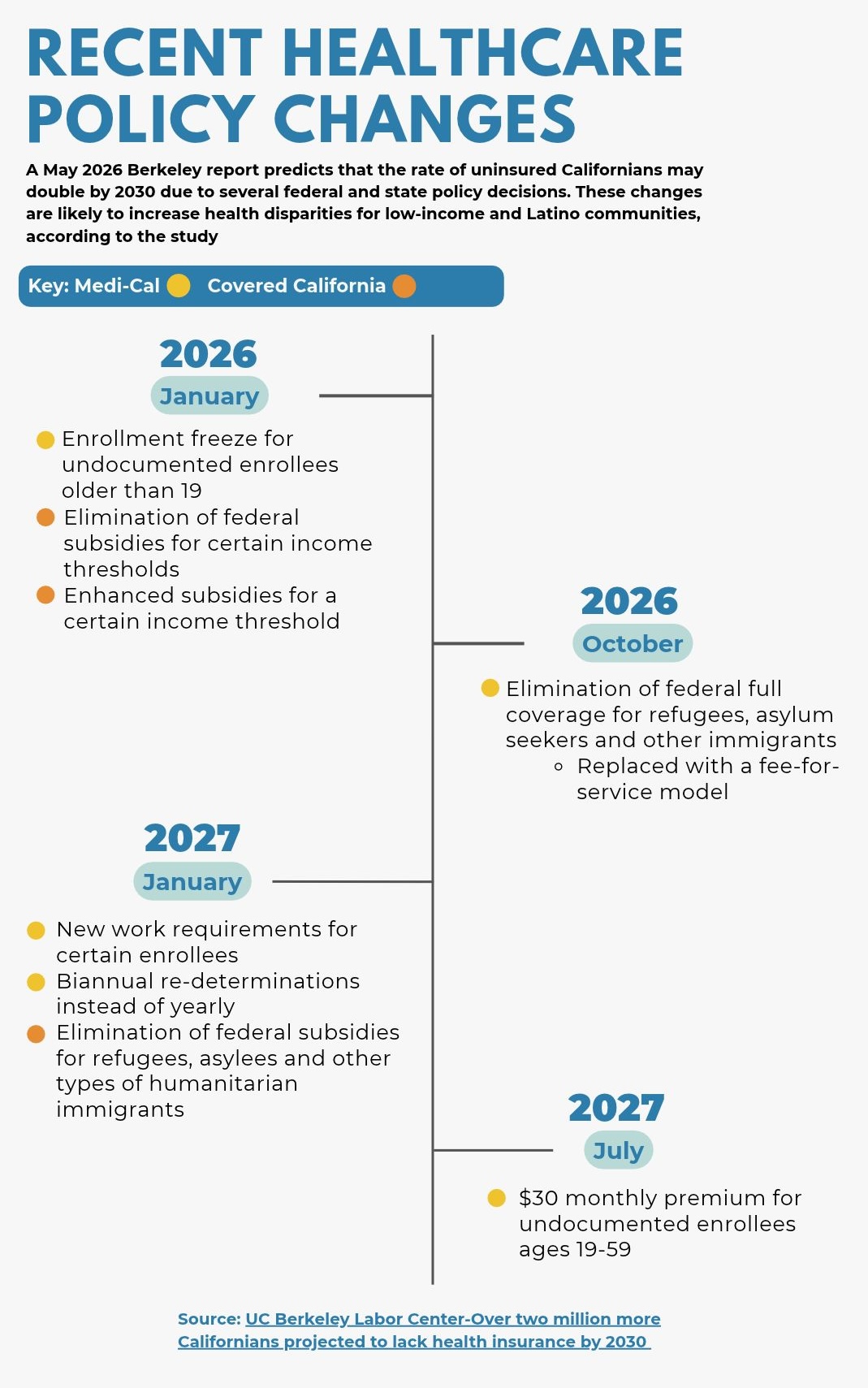
For the last decade, California’s Medi-Cal system had expanded to allow people regardless of immigration status to apply. As a result, about 1.6 million undocumented Californians are enrolled in Medi-Cal, according to CalMatters. Yet, as program costs grew higher than expected, critics questioned whether the state should fund programs for people without legal status.
“We had started building a foundation where we thought we would continue to keep everybody covered,” Floribel Tabizon, Kheir senior director of patient services, said. “Obviously, that has changed.”
To continue getting the word out, community clinics are expanding their outreach efforts. The Kheir team has been creating YouTube videos and handouts to keep patients informed about upcoming changes in all five languages they provide services in.
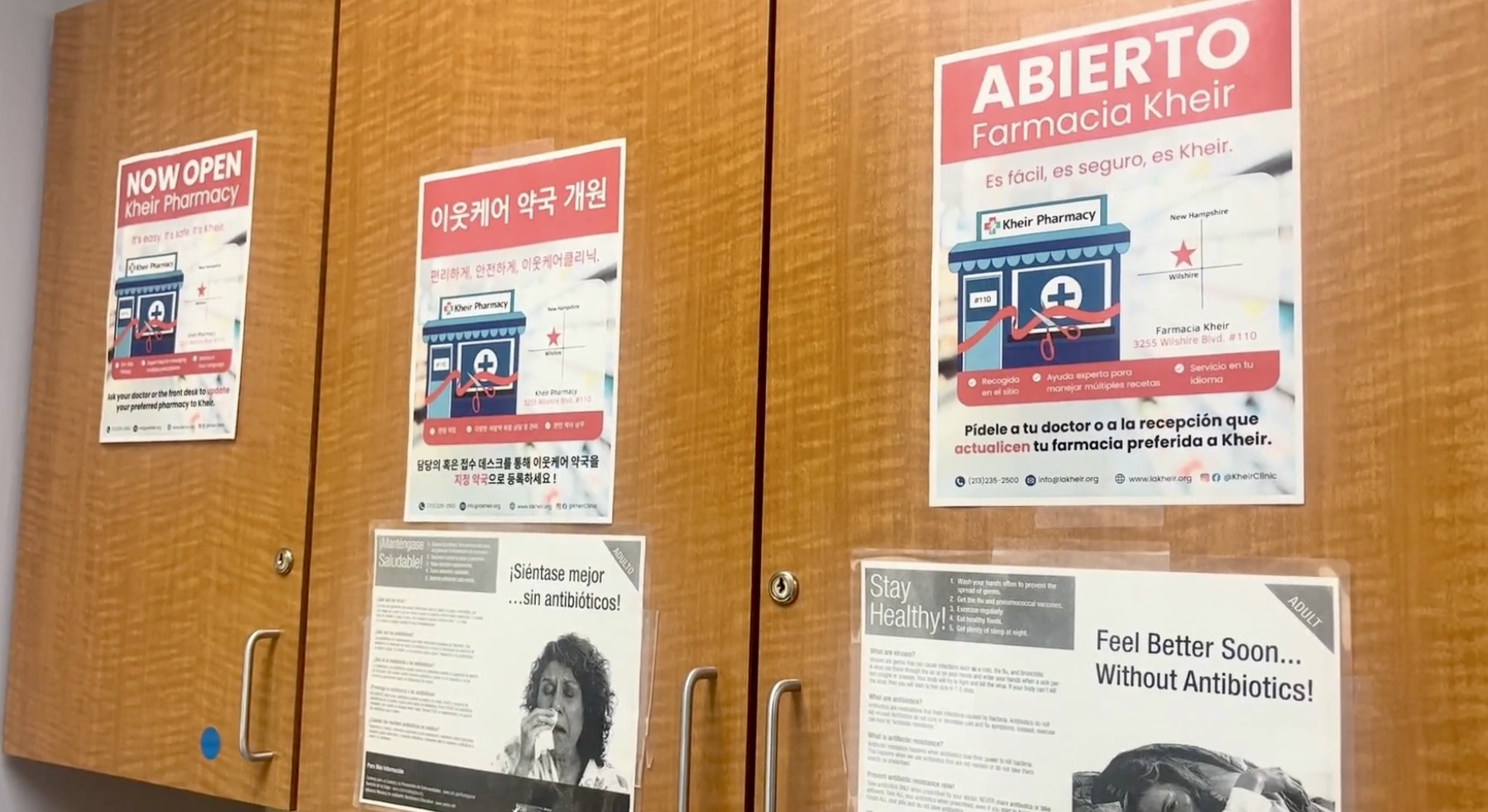
Signs inside Kheir Clinic in English, Spanish and Korean, illustrating the range of patients they work with. (Photo by Michelle Cisneros)
Another significant challenge from the clinics’ standpoint is Prop 44, which would require community clinics to spend 90% of their revenue on patient care. Clinics that don’t comply with the new requirements would be fined. Supporters of the proposition argue that capping administrative costs matters more than ever because of healthcare cuts.
According to all clinic employees interviewed, Prop 44 would limit many services they provide, such as patient transportation and language translation. Case managers who help enroll patients in government programs fall within administrative costs, in turn cutting that service. If the proposition passes, the state’s attorney general would decide what expenses advance a clinic’s mission. As a result, clinics would be at risk for closure.
“It's not actually feasible to operate that way,” said Stenberg from UMMA.

Leigh Stenberg, UMMA Clinic’s chief strategy officer, explains the center’s sliding fee scale for payment. The scale allows patients to pay what they can based on their income and household size. (Photo by Michelle Cisneros)
Staying the course
While these changes loom overhead, clinics are staying the course to provide care. Inside one of UMMA’s dental offices on school grounds, several patients mull over appointment details with their providers. Outside, people sit in a garden used to host health advocacy workshops for students.
Many of these policy changes underwent several proposed revisions before being finalized in June. It isn’t easy to communicate policies that are in constant flux, especially when someone’s health is on the line.
“It’s heavy,” Priscilla Monserrate-Sanders, senior director of quality and population health at UMMA Health, said. “It's been a general sense of every day a new dread, it seems, with what's coming down.”
She added that staff recently received additional de-escalation training because of rising tensions in the waiting room. Since these trainings, there has been a drop in escalations.
“Patients are definitely on edge, nervous,” Monserrate-Sanders said.
As a place that serves many undocumented immigrants, community clinics have felt the impact of increased enforcement. Outside the Angeles Community Health Center, a sign in Spanish explains what to do in case of an encounter with Immigration and Customs Enforcement. Another sign explains the clinic’s commitment to patient privacy.
“Patients are still terrified about leaving their home sometimes,” Stenberg said.
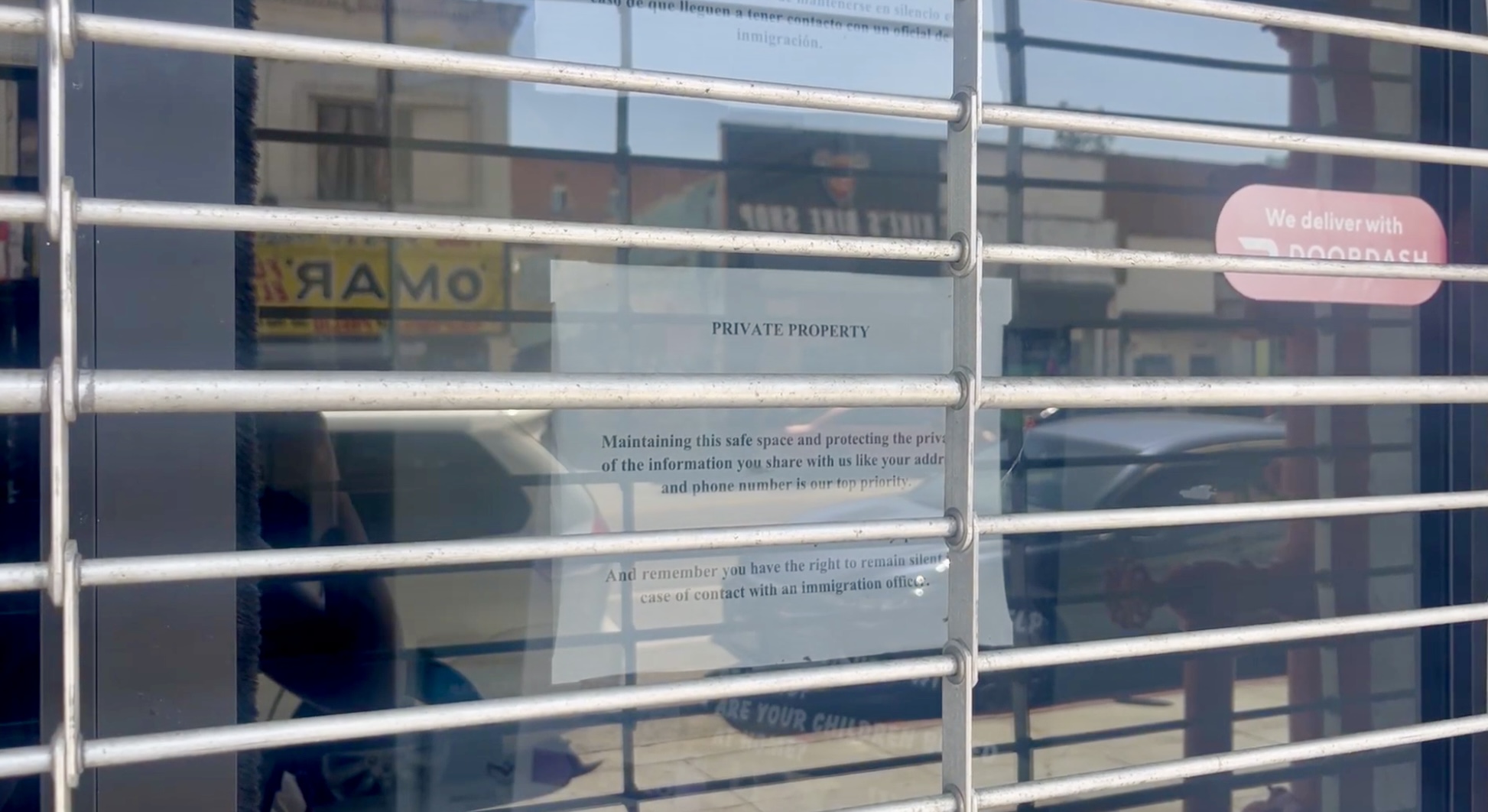
A sign outside the Angeles Community Health Center states that the clinic is private property. Immigration and Customs Enforcement agents are generally not supposed to enter private property without a warrant. (Photo by Michelle Cisneros)
Community clinics are also witnessing challenges with adolescent mental health. According to the Centers for Disease Control and Prevention, about 20% of adolescents surveyed reported that they had mental healthcare needs that weren’t met. UMMA has several sites directly on school grounds that will soon receive additional mental health support staff.
“We see more patients needing additional support,” Monserrate-Sanders said.
A chain reaction
These cuts may be felt across the entire healthcare system. If fewer people are insured, they could be more likely to go to the emergency room and overwhelm other health centers. Delays in care can also result in costlier needs later on.
“If suddenly we have a lot more people uninsured … our system is just not going to work well, and a lot of people are going to go without care they need,” said Paul Ginsburg, a USC health policy professor.
In June, L.A. passed a new tax known as Measure ER in anticipation of federal funding cuts to healthcare. However, an ongoing lawsuit from the L.A.’s Libertarian Party has frozen the funds until the case is resolved.
As clinics wait to see the outcome of the midterm election and new policy rollouts, employees say they remain committed to providing healthcare to all.
“Despite all of these hardships, we're still moving forward, and we want to just provide the best care we can for our patients,” Stenberg said.

