From grassroots art collectives to large institutions, L.A. is redefining its identity
as a cultural capital.
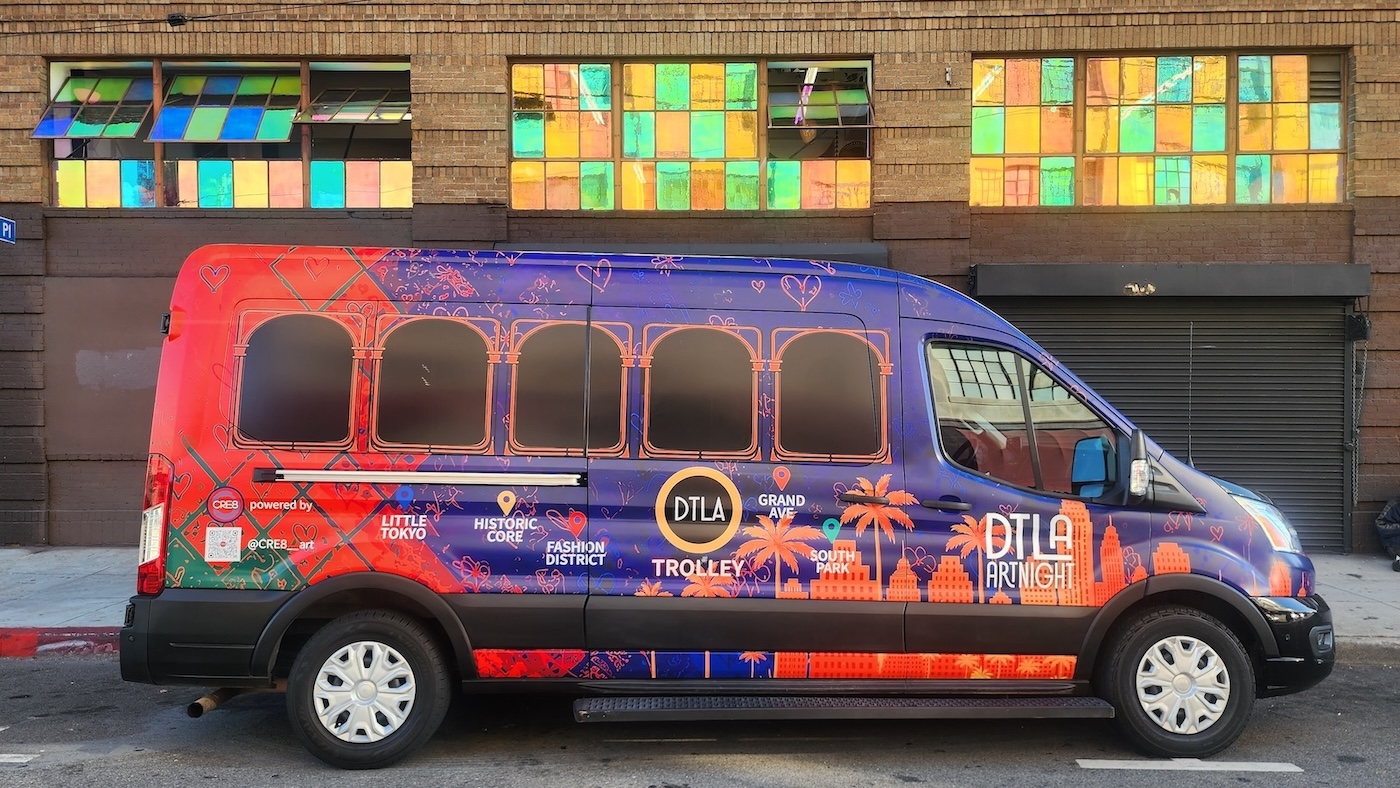
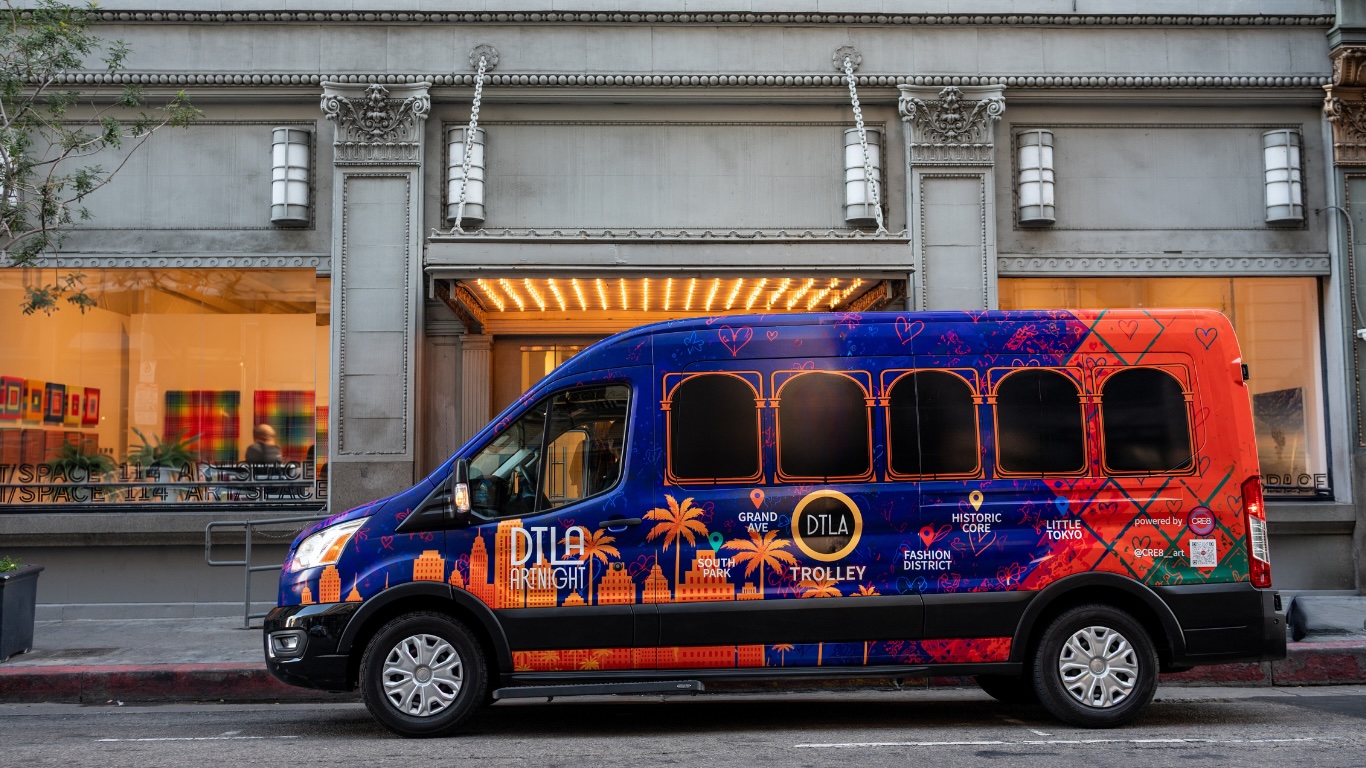
“Oh s—! Get in!,” white-mohawk and pink suit-bedecked Kalise Wallace yells to a group of art lovers over the traffic of Downtown Los Angeles. She waves them over to her “trolley”, a shuttle that transports DTLA Artnight visitors through the neighborhood’s arts districts. The red light turns to green as they hustle in. “Where are you all coming from?," Rafael Gonzalez asks from the darkness of the shuttle. He is president and CEO of Grand Performances.
“The Braly,” they say. “Oh my God, that’s my gallery!,” Sidney Brocious yells from the window seat.
Wallace and her V.I.P. passengers are unofficial historians of the DTLA (the colloquial term for Downtown L.A.) art scene. They hadn’t seen a night this vibrant since before COVID. But the energy pulsing through the city reminds them of the thriving scene they knew was possible all along.
Every First Thursday, Downtown galleries, museums, clubs, and restaurants open and extend their hours for DTLA Artnight. Wallace, co-owner of a gallery and cultural arts center called CRE8, created the Artnight trolley to connect the area’s arts spaces, many of which were isolated or neglected on mainstream maps. “I cried when [it] came out of the wrapping like a big baby,” she said. “I was like, ‘It’s real. We’re all going to come together.”’
“It feels like [the city’s art scene] is in a renaissance.”
Kalise Wallace
Her mission came out of a “weird COVID epiphany”: “I thought, when I get out of here, I’m going to try to unite people and bring art. I wanted to create something that would help the society, help artists, help people, bring community together.”
Downtown L.A. was hit so hard by COVID—visitation was cut almost in half, and homelessness jumped 12.7%— that many Angelenos called it a ghost town and steered clear. But Artnight shows signs of a rebirth. Food truck-lined streets filled with art lovers are a snapshot of a scene that can only be described as alive.
“It feels like [the city’s art scene] is in a renaissance. This is the time — the magic is coming alive again. Everything’s building toward a kind of burst,” Wallace said.
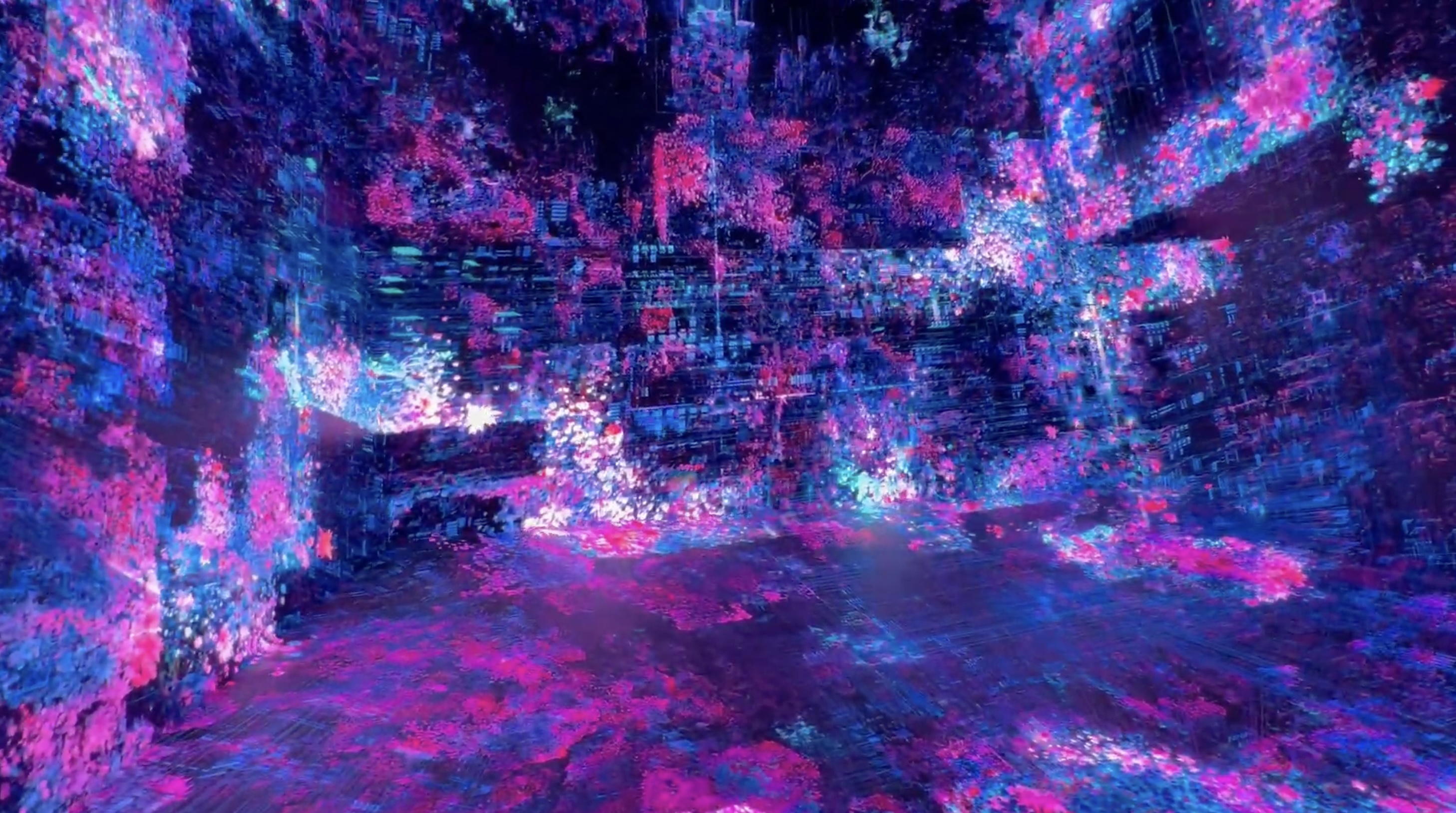
Right now, it’s bursting at the seams. DATALAND, self-dubbed the “world’s first museum of AI arts”, opened in June of this year. The Broad, a contemporary art museum, is in the middle of a $100 million expansion. If you drive out of DTLA (in your own car or public transit—the trolley doesn’t stop there yet), the rest of the city is changing too.
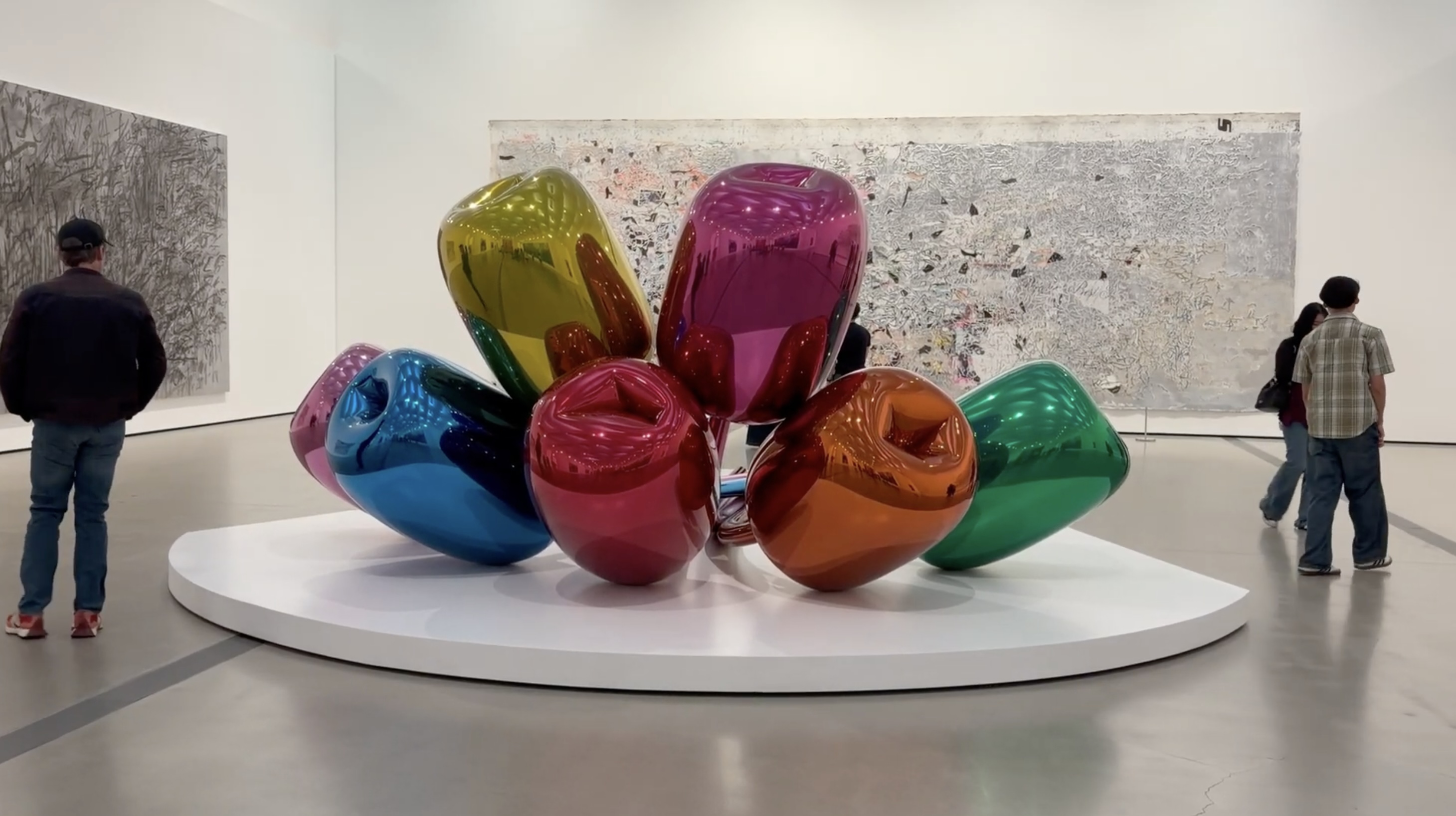
On Mid-City’s Museum Row, the David Geffen Galleries at Los Angeles County Museum of Art (LACMA) opened in April after a polarizing $724 million renovation. In South Central L.A.’s Exposition Park, The Lucas Museum of Narrative Arts will open in September. And down the 405, in Brentwood, The Getty Museum will close in 2027 for a year-long renovation. It’s a lot to happen at once.
L.A.’s art scene is in the middle of an over $1 billion dollar transition. The simultaneous development of galleries and museums is shaping the city’s arts landscape into something new: an ecosystem of institutions and individuals driven by community, immersivity, and innovation.
“Everybody’s on the same page,” says Wallace, “from the big players to the small players.”
Building an Arts Ecosystem
Omelet restaurant and art gallery-turned folk art museum Craft Contemporary is in a yellow and white-striped building on Wilshire, just across the street from LACMA. It was founded in 1965 by a group of women art enthusiasts.
Rody N. López, the museum’s current executive director, sees the momentum building across the city. “L.A.'s art scene is now, more than ever, more collaborative and interdisciplinary.”
Over 60 years after Craft’s opening, Downtown artists and arts business owners are similarly working together to revitalize the often overlooked area.
DTLA Artnight, organized by Happening in DTLA, is a partnership of 56 museums, galleries, performance venues, restaurants, clubs, and art spaces. Larger L.A. institutions are also partnering to create collaborative exhibitions with smaller venues and even community spaces.
A recent exhibition From MacArthur Park, With Love, was co-presented by LACMA and Charles White Elementary and Visual Arts Magnet, a satellite gallery for the iconic institution. The exhibition featured the artworks of over 100 elementary students.
This reflects what Michael Govan, LACMA’s CEO and Wallis Annenberg Director, says is a large-scale change in attitude towards visitors and community members. Museums and cultural institutions “are [no longer] there as part of an ivory tower of scarce and rare resources, but rather very deeply integrated into their communities.”
Craig Krull, an L.A. native art historian, says that the city’s unique sense of community establishes it within a broader arts scene.
“I’d say we’re probably one of the art capitals of the world right now for the community and the vibrancy of what’s happening here,” says Krull.
Few people have an encyclopedic knowledge of the city that could compete with that of Krull, who has owned the Craig Krull Gallery for 32 years.
“[The scene] continues to evolve,” he says. “[And] It evolves very fast.”
“The New City”
Because L.A. has less-established museum history than East Coast cities like New York and Washington, D.C., it’s long been a city of infinite potential. “I think the story on LA,” he says, “is it’s sort of ever new. It’s ever in renewal.”
One could argue the scene has been evolving since the 1960s—which Krull claims is when it really began. In this decade, artists like Ed Ruscha, Betye Saar, Craig Kauffman, and Robert Irwin rose to fame. LACMA opened in 1965, just after the Craft Contemporary. Southern California artists started the Light and Space movement in the 1970s, pioneering the minimalist, light-filled art style whose influence can be seen anywhere from Drake’s “Hotline Bling” music video to Apple stores.
L.A. finally got the art world’s attention when the Geffen Contemporary at MOCA opened in 1983. Galleries opened throughout the 80s and 90s, including Bergamot Station Arts Center, home of Krull’s Santa Monica gallery, which opened in 1994. According to Krull, a wave of international and New York galleries like Matthew Marks, David Zwirner, Jeffrey Deitch, and Hauser and Wirth have come to L.A in the past 15 years, resulting in what he calls an “oversaturated” market.
A History of Arts in L.A.
“People say we have more artists living in L.A. now than any city in the history of mankind,” Krull says. “We have more galleries than we’ve ever had, certainly. Probably 300 good, strong, galleries.” According to a 2026 report, Los Angeles has 306,000 professional artists and L.A.'s art market (auctions, galleries) generated $2.1 billion in 2023.
And yet, few think of L.A. as an “art city” in the same vein of New York, or even its California neighbor, San Francisco. When most think of L.A., they’re likely thinking of Hollywood. The Walk of Fame. The Hollywood sign. “The City of Stars”.
“People think [the movie business] is all we are, but we’re growing past that,” notes Wallace. “I do feel L.A. has changed a lot artistically.”
Wallace, an L.A. native, started her career as a production designer, working on TV and movies like Sharknado, WOW: Women of Wrestling, The L Word, and Z Nation. She has two decades of experience, but when she sensed a Hollywood decline, she knew it was time to pivot to the gallery scene.
L.A. art for modern times
Wallace always wanted to go into her closet to find Narnia. So now, she builds worlds herself. “Immersiveness is so attractive—to create what’s in my head and watch people walk [through] that. Maybe it’s an ego thing, but I love it."
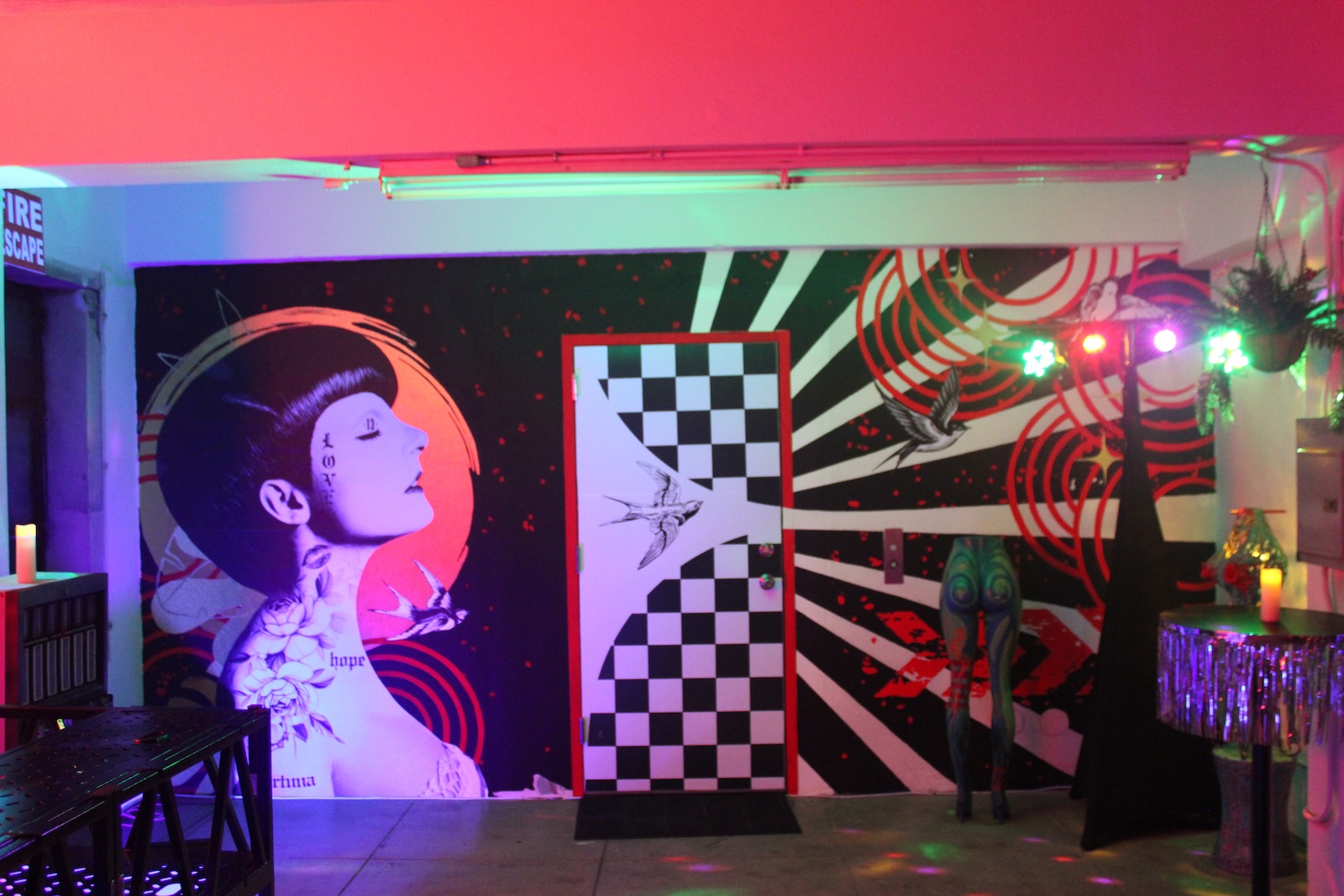
Upon entering CRE8 (perhaps for an upcycling night, birthday party, or other community event—it doubles as an event space), a barrage of sights and smells greet you. It’s like walking into a chopped and screwed, L.A.-set Alice in Wonderland.
Pop and EDM blast as guests walk through fog-filled sets, get their fate examined from a fortune-telling ATM machine, smell bug-like plushes that emit scents of dirt and plants, or play retro video games on Nintendo 64s. It’s a monument to play—almost everything can be touched—intentionally made this way by Wallace, who says she’s like a big kid (when she worked on the set of Marvel Agents of S.H.I.E.L.D., she would go onto plane sets and play during her lunch breaks.)