The Struggle For Accessible Housing
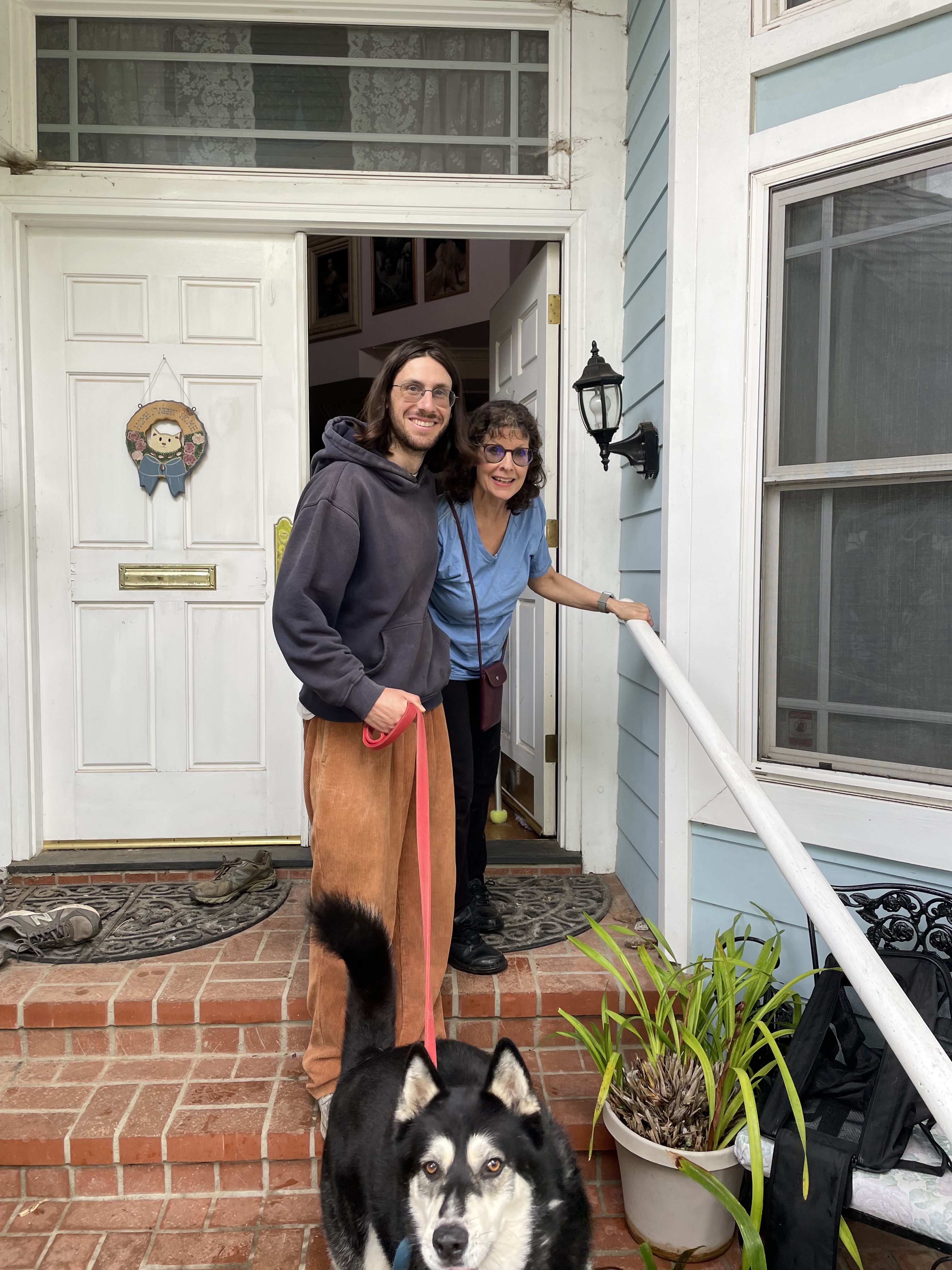
Brian and his mom, Beth, outside their Palisades home. Photo courtesy of Brian Schlaff.
On the morning of January 7, the winds were so loud in the Pacific Palisades that Brian Schlaff didn’t hear the alarm that was supposed to wake him.
Waking up suddenly, Schlaff prepared for what he thought would be a normal day of running errands. When he stepped outside to get in his car, he saw the flames of what has since become known as the Palisades fire — the worst fire in Los Angeles history — heading in his direction.
He went back inside and grabbed premade emergency bags for his mother. Beth Schlaff, who had been diagnosed with primary progressive multiple sclerosis in 2012, was 64-years-old and needed a walker. Her nerve function had gradually gotten worse over time. She had also been diagnosed with Raynard’s disease, where blood vessels narrow in response to stress, leading to swelling in the hands and feet.
With the fire just three houses away, he recalls, they left the home that his family had lived in for three generations. Schlaff, an Earth Sciences PhD candidate at the University of Southern California, knew the house wouldn’t survive. His mother grew up in the house. “It's been a big, huge shock, especially for her.”
They spent the next hours at a friend's house in the West Adams neighborhood of South Los Angeles, and managed to secure an Airbnb in Glendale for the night.
One hour after arriving at their temporary lodging in Glendale, he says, the Eaton Fire broke out in Altadena, just 10 miles away. The next day, they received an evacuation order and rushed to a family friend’s house, “I ended up carrying my mom up the stairs while juggling all the logistics with our dogs,” he explains.
Soon after, they rented an Airbnb in San Diego, which came with its own set of challenges, especially a shower that Beth struggled to get in and out of, Schlaff says.
There was also the bed, which was so soft that Beth could only get out of it on her own with great difficulty, Schlaff says.
For people with other mobility-related disabilities like cerebral palsy, medical beds with rails are essential so they don’t roll out of bed and harm themselves, but that’s an “amenity” a typical Airbnb wouldn’t have.
In 2022, Airbnb calculated there were approximately 150,000 such “accessibility features in nearly 100,000 places to stay around the world.” That is just 1.5% of the 6.6 million homes the company offered at the time.
A subtle yet debilitating effect of natural disasters for people with disabilities can be the loss of routine. Schlaff’s mother used to exercise on an elliptical at home — one of the few exercise machines she could use to maintain her strength and mobility. Without one for weeks after the fires, she suffered “a big setback,” says Schlaff.
Amid the stress of losing the family home, Beth’s Raynard’s disease worsened. She developed bruising in her bad leg and the swelling in her hands and feet grew.
“The nurse thought it was a blood clot, so we ended up going to the ER for 10 hours,” Schlaff explains. After ruling out a blood clot, doctors re-prescribed her anti-Raynard’s cream, which burned in the fire, along with a neural sleeve for her leg that made it easier to walk.
Schlaff says the family will continue to live in Airbnbs while they search online for longer-term housing that is ADA accessible and pet-friendly, which has been “difficult to find.”
Although over 600,000 people under the age of 65 in Los Angeles County have a disability, according to U.S. Census data, the Los Angeles Housing Department currently lists only 421 properties under its Affordable and Accessible Housing Registry, where people with disabilities can put their name on a waitlist for affordable units with accessibility features.