The Inanimate City
Should L.A. County's Tiniest City Become a Power Hub for Big Tech?

By Isaac Vargas
Seated attendees booed and shouted “cowards” as officials filed out of city chambers for an abrupt recess.
Officers in green sheriff’s vests escorted Samuel Brown from the room as the crowd rose into a chorus of complaints against a neighbor many say hardly listens.
The outburst came during a City Council meeting over fears that new battery facilities were precursors to data centers.
“We’ll be here when you come back,” one attendee shouted.
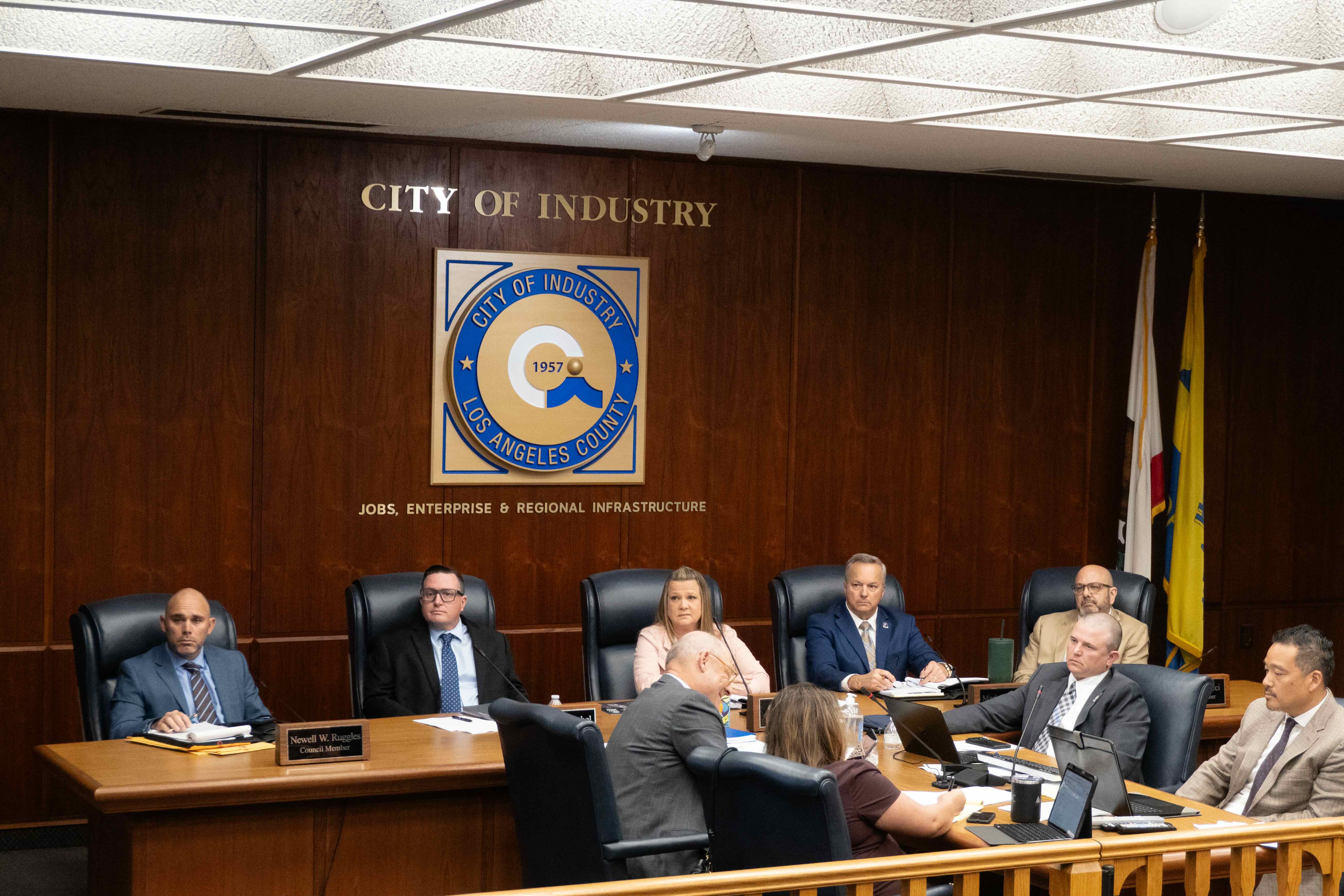
Mayor Cory Moss (pink suit jacket), council members, the city attorney and city managers listen to public comment opposing battery storage facilities and rumored data centers. February 27, 2026. Credit: Isaac Vargas.
The City of Industry is where Southern California stores, sorts and ships itself.
Roughly 3,000 businesses operate there, employing tens of thousands of workers, generating more than $30 billion in annual sales.
Hundreds of semi-trailers pass through the region east of Los Angeles, and increasingly, developers see the city as a place to power the digital future.
Nearly $1 billion sits in Industry’s reserves, making it one of the wealthiest municipalities in the San Gabriel Valley. Its economic output rivals that of small nations. That wealth can give the city unusual influence over what gets built next. Those decisions are felt by residents living just over the city’s gerrymandered limits.
All of this for a city of only 264 people.
Use the slider to compare Industry’s street and satellite views.
A CITY BY NO ACCIDENT
In most cities, projects face scrutiny from neighborhood groups, crowded electorates and residents worried about traffic, pollution or land use. In Industry, there are far fewer voters to persuade.
Critics say even public participation can be difficult. Council meetings are typically held on weekday mornings, when many residents are at work.
“Our audience are our businesses, and they want our business being done in the morning,” said Assistant City Manager Sam Pedroza. “Since we’ve been created as a city, that’s always been the case.”
Before the City of Industry was first incorporated in 1957, newspapers described a proposed map with jagged borders, too few voters and what a newly appointed city manager would call “a city without people.”
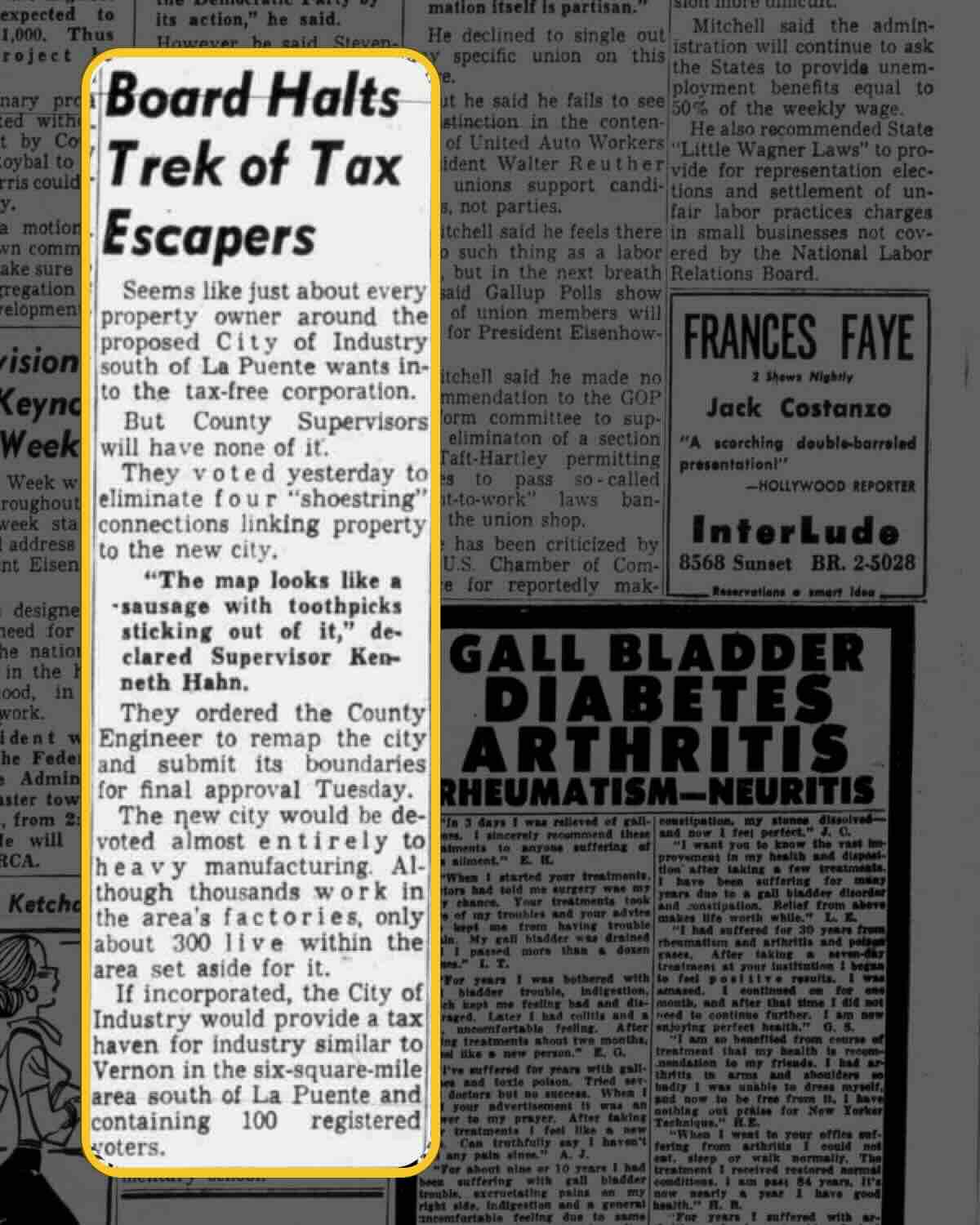
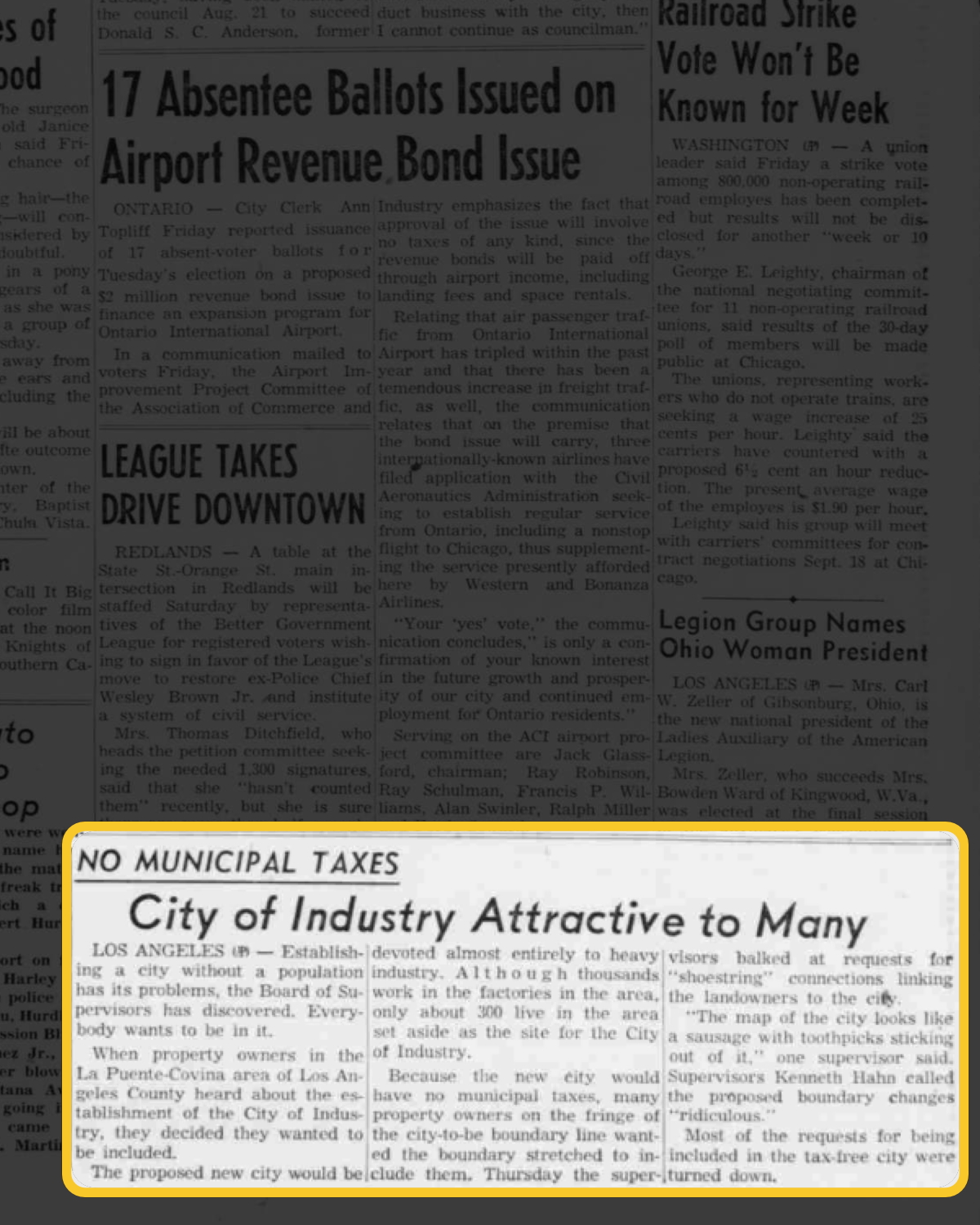
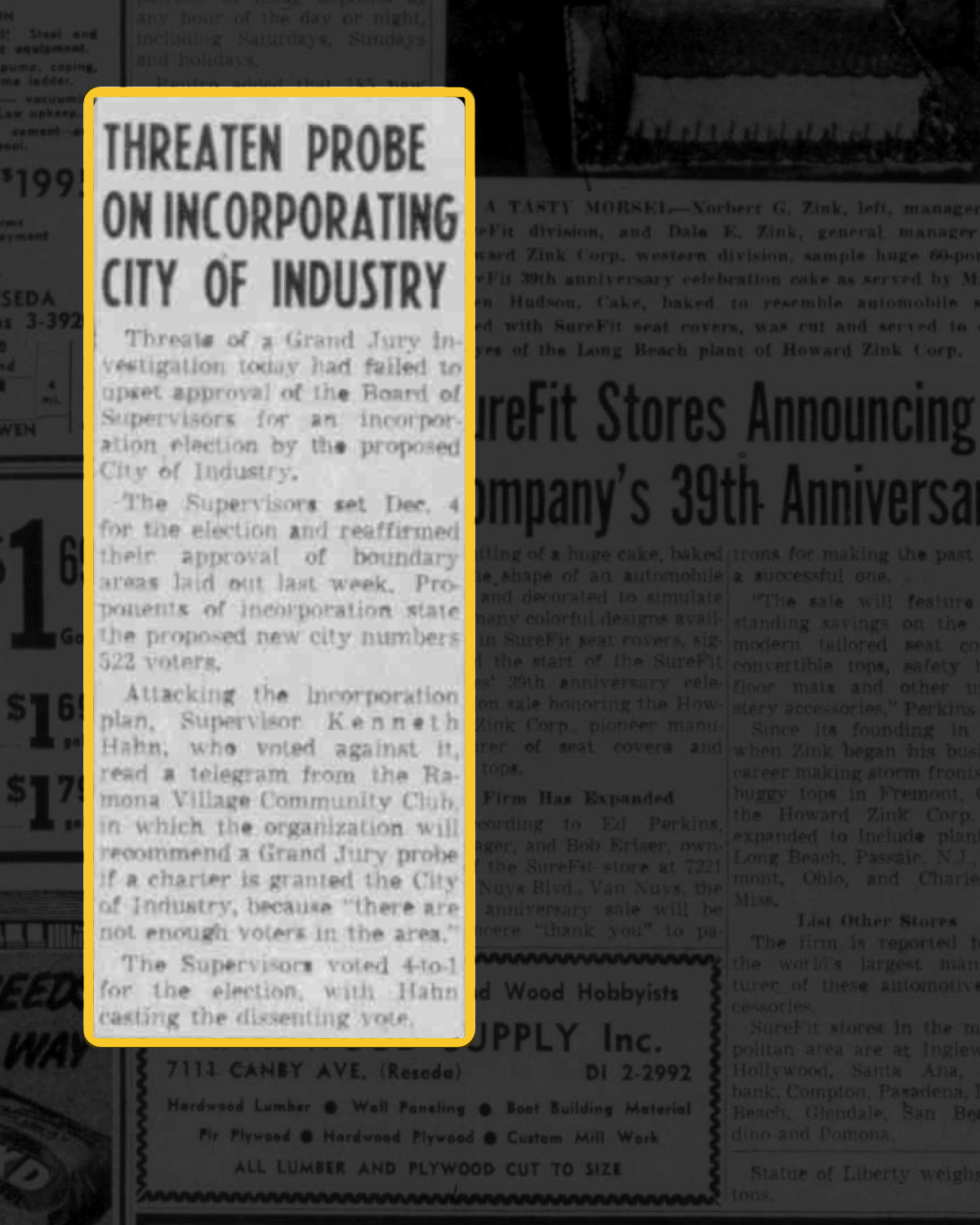
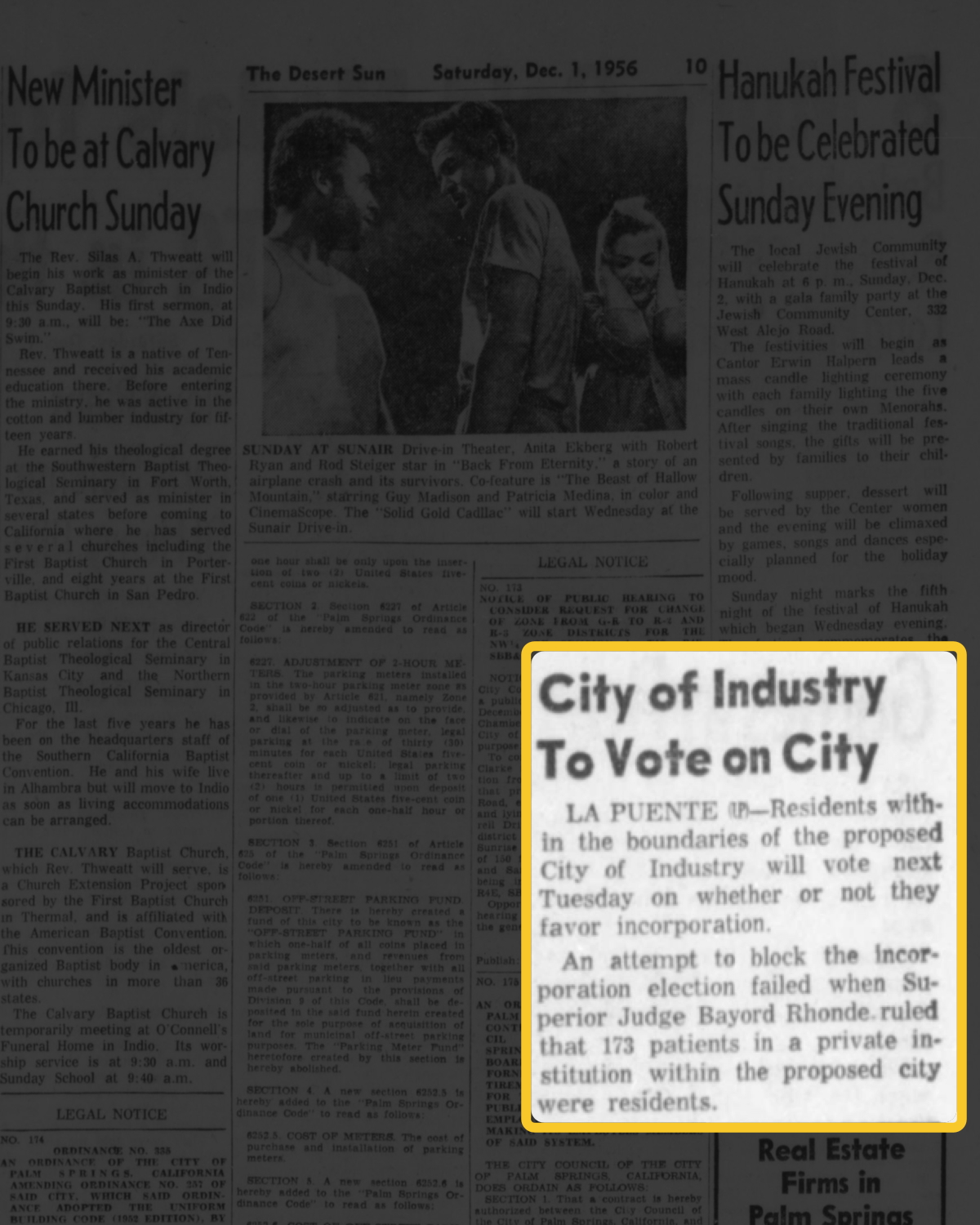
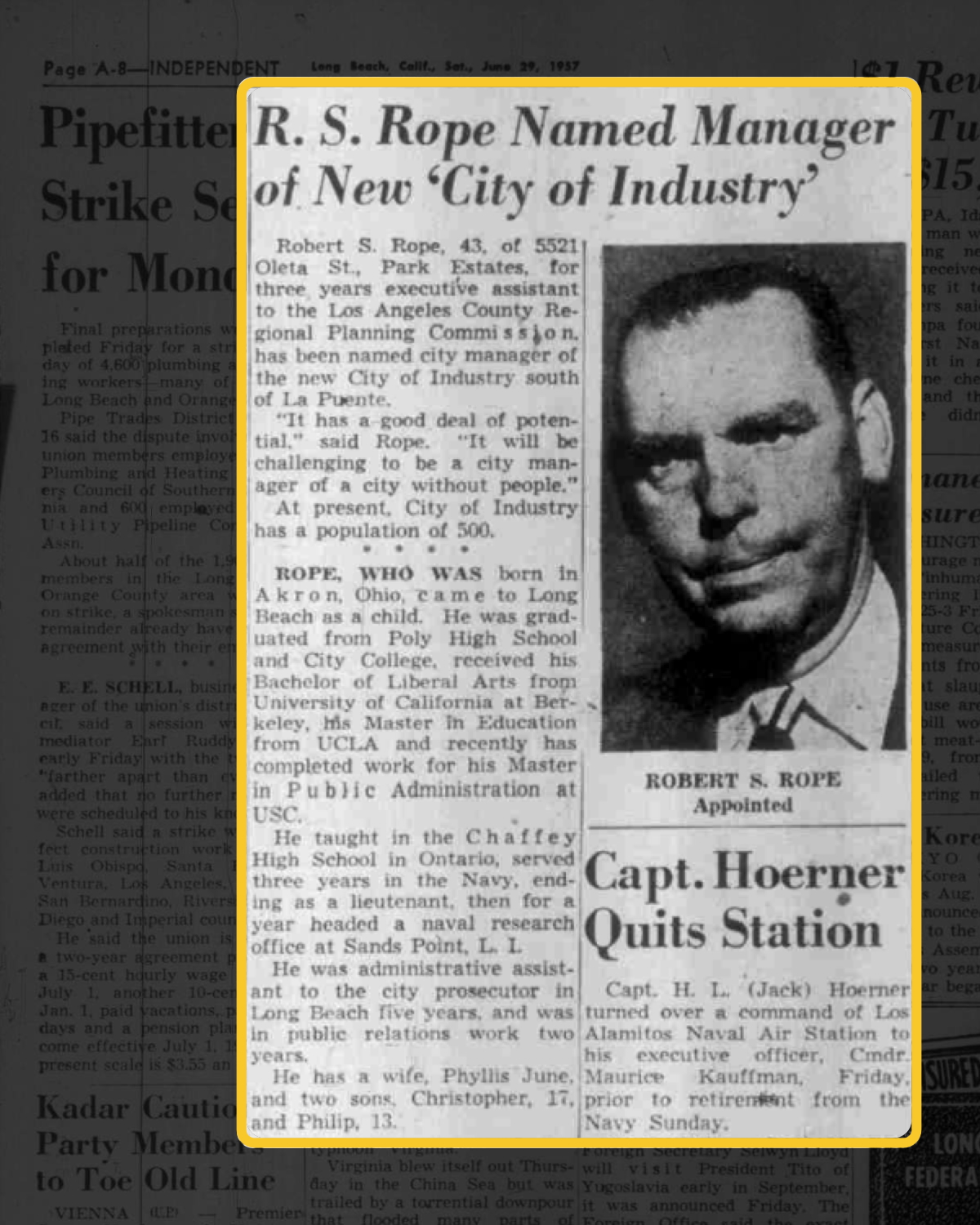
At the time, the proposed city did not have enough residents to meet the legal threshold for incorporation. Industry supporters redrew the map to include El Encanto Sanitarium, adding 169 patients and 31 employees to the population count.
The city built for business was incorporated with a population of 629. Critics at the time called it a fraud.
One L.A. County Supervisor warned Industry was a town “which would employ thousands of citizens of the San Gabriel Valley, but would provide a voice to virtually none of them.”
FEWER VOTERS, MORE POWER
More than half a century later, democratic participation remains strikingly small.
Since 2005, ten of the city’s 13 general elections have been canceled. Past voting records reviewed by the San Gabriel Valley Tribune found that many of the city’s residents lived in homes owned by the city. In some elections, a large share of ballots came from city officials, employees, or their relatives.
The city has faced repeated controversies over governance and the concentration of political influence. In 2015, Industry sued former Mayor Dave Perez and four relatives, alleging they profited from city contracts. The suit alleged the misappropriation of millions in public funds.
In 2020, the city’s most recent election to date, just 41 total votes were cast in a recall election that removed a sitting councilman.

Geri Renswick grew up in the area and worked for decades in the Los Angeles Unified School District. Now retired, she attends council meetings worried that the beloved Puente Hills Mall, Industry’s major commercial property bordering unincorporated Hacienda Heights and Rowland Heights, could be turned into a data center.
“What the City of Industry has done is they have encroached on all of the communities, but the ones that they impact the most is unincorporated L.A. County,” Renswick said. “All they’re about is making money for the industries that come in.”
Industry borders several unincorporated communities, including Hacienda Heights, Rowland Heights, Avocado Heights, West Puente Valley and South San Jose Hills. These places host tens of thousands of residents who rely on L.A. County supervisors, rather than a city hall of their own, to voice concerns over nearby development.
Census figures show many of the neighborhoods bordering Industry are heavily Latino or Asian American. Rowland Heights, Walnut and Diamond Bar have large Asian populations, while La Puente, South San Jose Hills and Avocado Heights are majority Latino communities. None of them vote on what Industry builds next.

Samuel Brown, an Avocado Heights community organizer, is escorted out of city chambers just before the council went into an abrupt recess. February 26, 2026. Credit: Isaac Vargas
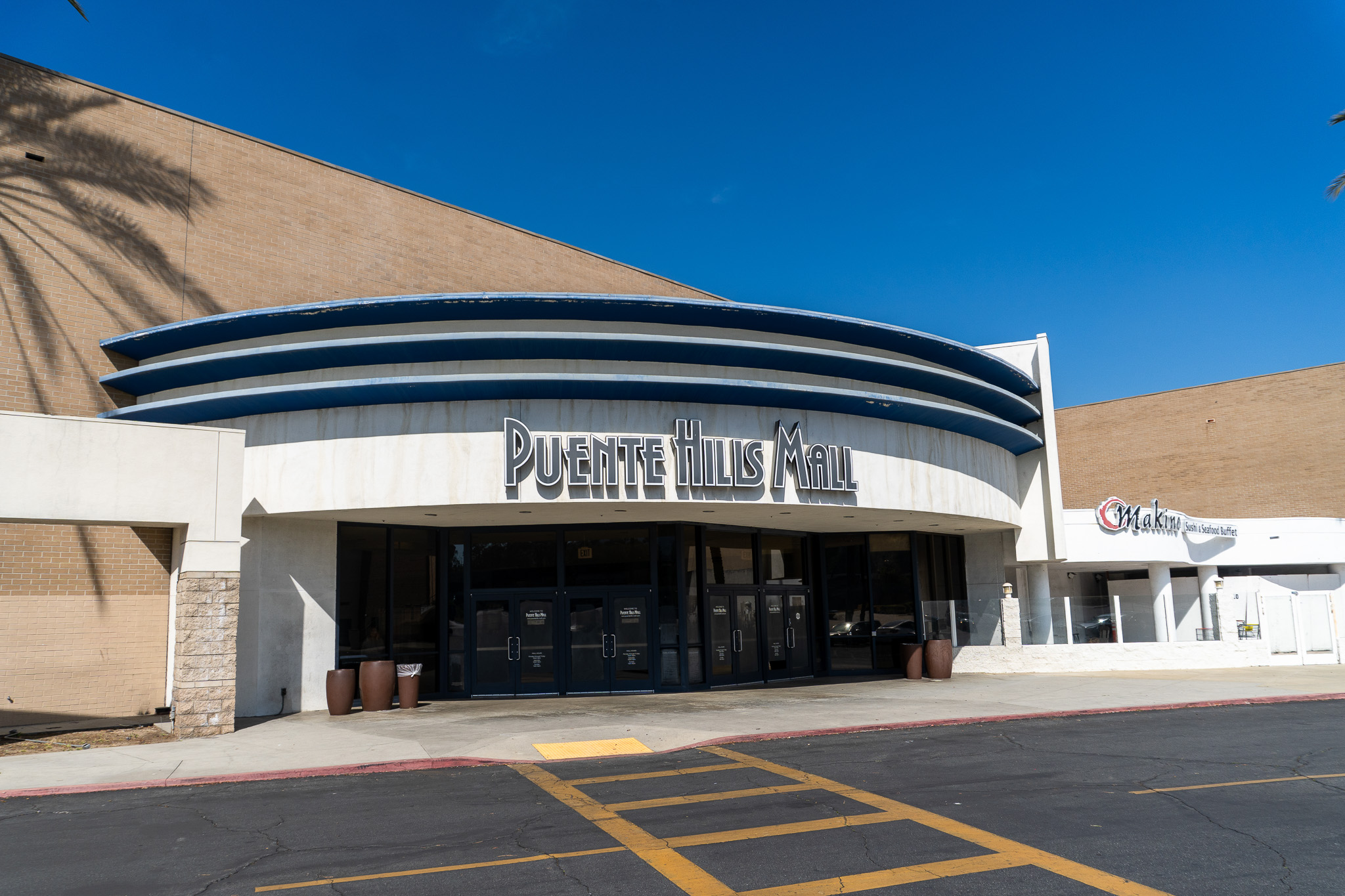
The Puente Hills Mall, famous for its appearance in the 1985 film Back to the Future, is among the sites City of Industry is considering for redevelopment into a data center. February 26, 2026. Credit: Isaac Vargas
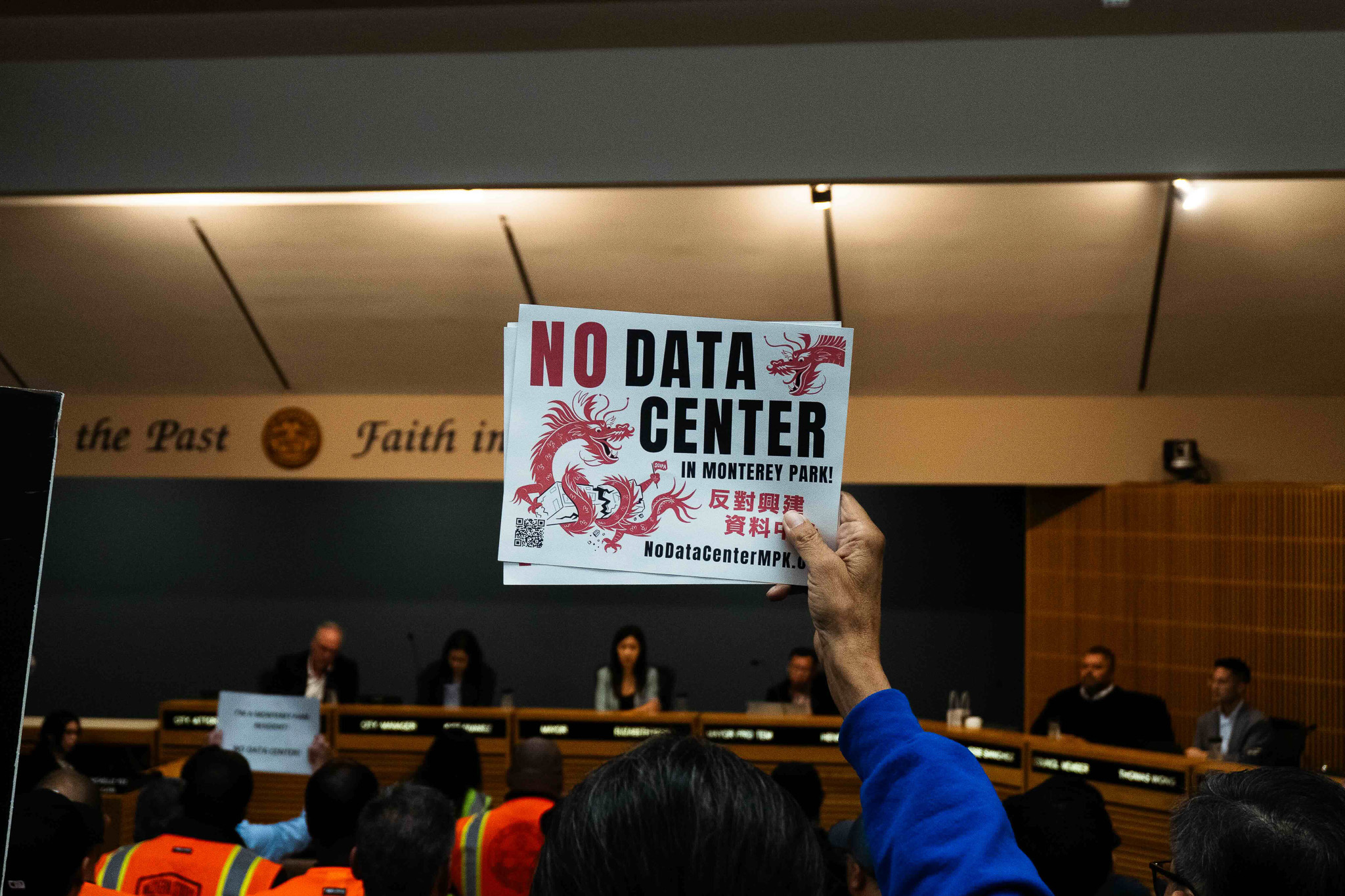
A resident holds a “No Data Center in Monterey Park!” sign during a City Council meeting discussing a proposal that could place a citywide data center ban on the ballot. February 4, 2026. Credit: Isaac Vargas
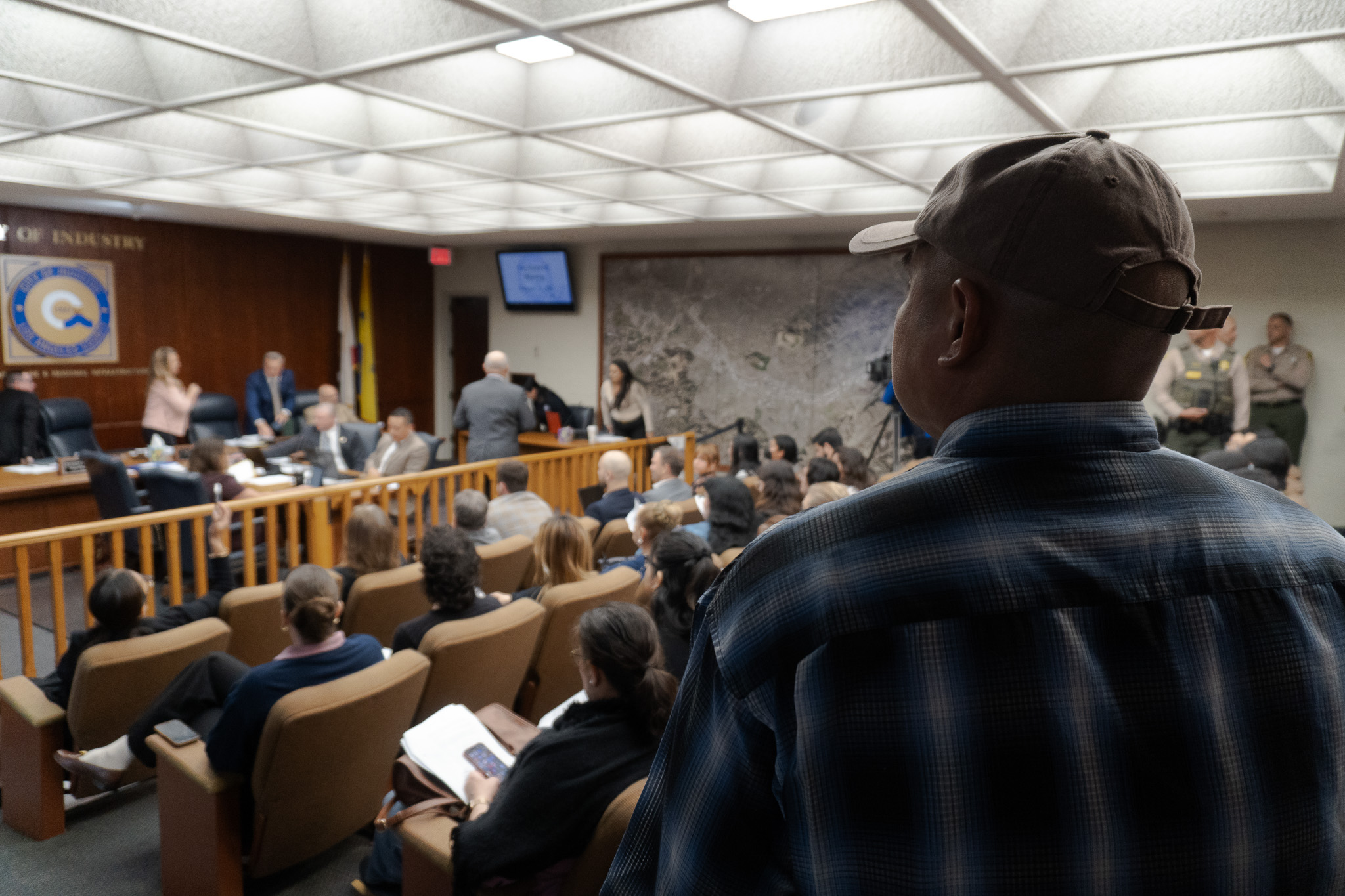
Jonathan Montalvo looks on as City of Industry officials file out of chambers for an abrupt recess. An El Monte resident, Montalvo was among attendees frustrated over the prospect of data centers and battery storage projects near residential areas. February 26, 2026. Credit: Isaac Vargas
THE NEIGHBORS OUTSIDE THE LINES
Brown, a resident of unincorporated Avocado Heights and longtime community organizer, was among the first to sound alarms over data centers coming to Industry.
“We’ve been dealing with City of Industry’s public health impacts for some time now,” Brown told Industry planning commissioners during a December 2025 meeting that voted to recommend zoning changes allowing data centers citywide. “We’ve got Quemetco that’s contaminating our communities.”
Brown was referring to Quemetco, the battery recycling plant in City of Industry that residents have fought for years over lead and arsenic exposure. County health officials said plant operations may have released harmful levels of lead and arsenic into nearby Hacienda Heights, La Puente and Avocado Heights. In 2024, state regulators granted Quemetco a new operating permit despite years of community opposition.
Frustration over data centers has helped fuel organizing efforts across the San Gabriel Valley. In Monterey Park earlier this year, opponents of a proposed data center packed council meetings and pressured city officials until the developer withdrew its proposal. Many are now turning their attention to Industry.
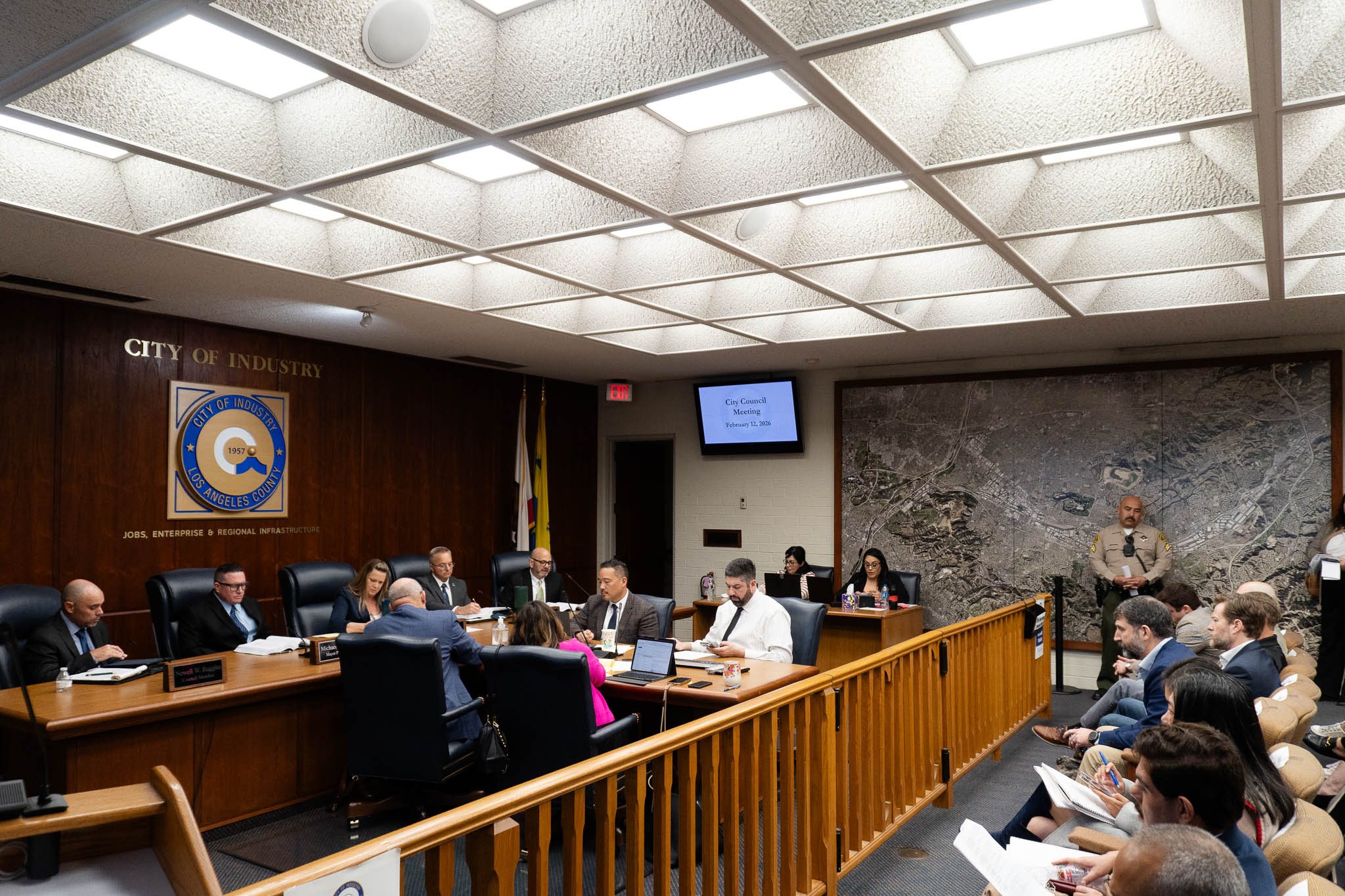
City of Industry council members consider and approve a 400-megawatt battery energy storage system that officials say would help stabilize the city’s energy backbone. February 12, 2026. Credit: Isaac Vargas
Nicholas Rabb, a Cal State LA postdoctoral researcher who has helped track the issue online, said communities too often accept large technology projects without considering how quickly they can become obsolete.
“When you look at the history of technology and how technology interacts with society, you start to realize that we have a huge deficit of long-term thinking,” Rabb said.
Despite Industry’s tiny electorate and long insulation from outside pressure, residents are increasingly organizing anyway. Brown has helped file formal resolutions with nearby school districts, including Bassett Unified, which operates a school within Industry’s city limits, and even repurposed leftover yard signs from Monterey Park for the fight in Industry.
Whether Industry becomes Southern California’s next hub for data centers and battery storage projects may depend not only on those who live inside its borders, but those who live just beyond them.